
The next wave of crypto adoption may depend less on convincing people to embrace crypto and more on giving them services worth using. Major technology and payments companies are developing products that bring blockchain-based money into familiar business systems. Stripe is building stablecoin services and recruiting people to sell and support them. Visa is expanding how financial institutions can settle payments. The commercial opportunity is to serve customers whose needs could be met through this technology, regardless of whether or not those customers care about crypto.
Hiring helps reveal how companies intend to turn that opportunity into a business. Stripe has advertised sales and solutions architecture roles focused on stablecoins, digital tokens designed to maintain a stable value, often relative to the U.S. dollar. Visa’s listings include responsibilities for stablecoin treasury operations and compliance. These functions help companies deliver and support services after the engineering work is done.
Apple’s payments strategy hiring represents a more exploratory commitment. Its advertised role identified stablecoin and blockchain knowledge as preferred expertise for work involving Apple Card, Apple Cash and broader payments strategy. Google Cloud’s advertised Web3 architect role focused on institutional infrastructure, including stablecoin payment networks and digital-asset custody. The postings reflect different business priorities and stages of development, rather than a shared timetable for launching consumer products.
The infrastructure behind crypto adoption
A business needs more than the ability to send a token. Its finance team needs secure access to funds, transaction approvals and records it can reconcile. Connections to bank accounts and compliance processes also have to work within daily operations.
Visa’s Stablecoin Platform brings wallet infrastructure and stablecoin access into a shared operating environment for financial institutions and payment providers. Stripe’s Bridge supplies tools for moving funds between traditional currencies and stablecoins. These services address some of the practical work required to introduce blockchain payments into an existing business.
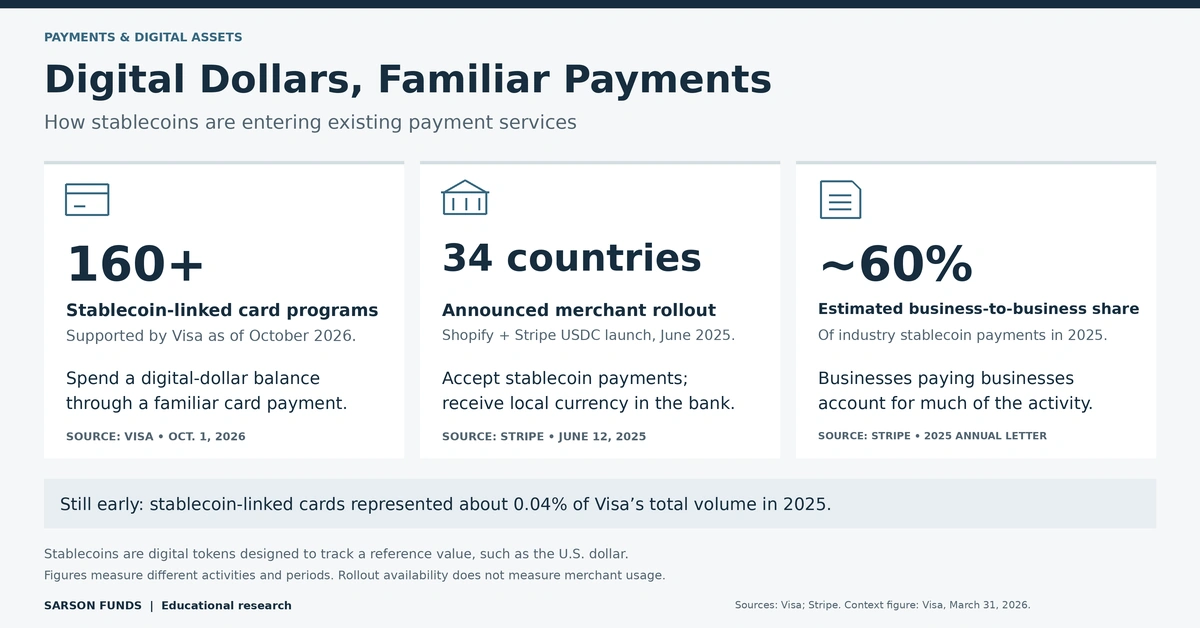
Stripe and Shopify’s USDC integration offers a concrete example. Eligible merchants can accept the dollar-linked stablecoin at checkout and receive proceeds in their local currency through their bank accounts. That gives a merchant another payment option without requiring it to hold stablecoins or manage the conversion itself. Shoppers choosing that option still need USDC and a compatible wallet, so the simplification is primarily on the merchant’s side.
Visa’s USDC settlement expansion applies a similar approach further behind the scenes. Participating financial institutions can use USDC to settle obligations with Visa without changing the consumer card experience. The blockchain activity takes place between institutions, while the cardholder continues making purchases as usual.
Familiar services give customers a reason to participate
These examples suggest that crypto adoption can take place at different levels. A merchant may accept stablecoin payments while continuing to receive ordinary bank deposits. A cardholder may use a payment network whose institutional partners settle some obligations on a blockchain, without personally holding digital assets.
That creates an opening among customers who see little reason to become active crypto users. A familiar service can make a new capability easier to evaluate on its merits. Does it solve a payment problem? Does it fit the way the business already operates? Keeping the interface familiar does not remove the underlying risks, but it can reduce the amount customers must learn before using the service.
The business case still has to hold up. Providers must deliver reliable services and meet regulatory requirements, while customers need a sufficient reason to use them. Hiring and infrastructure spending indicate preparation; sustained use will provide stronger evidence of demand.
Established companies already have customer relationships through which they can introduce these capabilities. That may prove consequential for adoption. A business owner does not need to become enthusiastic about crypto to value a payment service that works better.
Disclosures: This article is for informational purposes only and should not be considered financial, legal, tax, or investment advice. It provides general information on cryptocurrency without accounting for individual circumstances. Sarson Funds, Inc. does not offer legal, tax, or accounting advice. Readers should consult qualified professionals before making any financial decisions. Cryptocurrency investments are volatile and carry significant risk, including potential loss of principal. Past performance is not indicative of future results. The views expressed are those of the author and do not necessarily reflect those of Sarson Funds, Inc. By using this information, you agree that Sarson Funds, Inc. is not liable for any losses or damages resulting from its use.