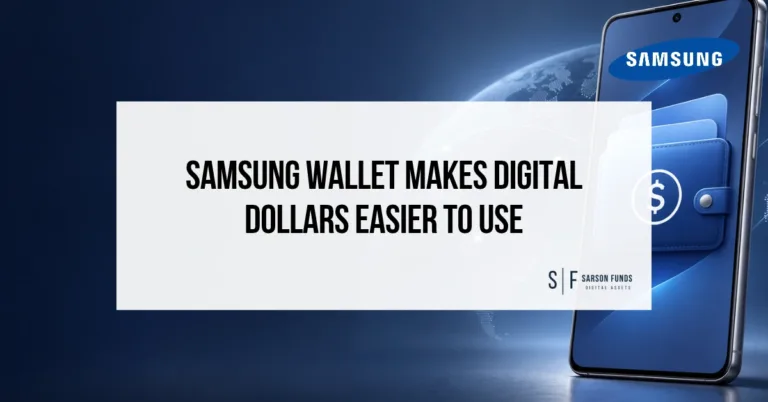
Samsung Wallet now lets eligible U.S. Galaxy users buy and transfer USDC without downloading a separate crypto app or managing private keys. USDC is a stablecoin issued by Circle, designed to track the value of the U.S. dollar. Its arrival inside a familiar phone wallet gives consumers another way to use blockchain-based money without first becoming customers
Related Article: Big Brands Are Building a More Familiar Way Into Crypto
Samsung says about 82 million U.S. Galaxy devices support Samsung Wallet. That represents potential reach, not enrolled users: Stablecoin Account access requires additional device and eligibility checks, account registration, and identity verification. Users can access the service within Samsung Wallet rather than downloading a separate crypto app. cryptocurrency exchange.
In Big Brands Are Building a More Familiar Way Into Crypto, we examined how established companies are bringing blockchain-based services into products people already use. Samsung’s rollout offers a concrete example: a person interested in sending money abroad can encounter crypto through that practical need, without developing an interest in trading.
Sending Money Through an Existing App
The Stablecoin Account launched with USDC on Solana, where its blockchain transfers settle. Users can send USDC to compatible external wallets or send money to qualifying bank accounts in more than 60 countries, where recipients may receive local currency. That second option matters because the recipient does not need a crypto wallet to receive the payment.
Stripe supplies the purchase infrastructure, allowing users to buy USDC through Samsung Pay, credit or debit cards, and ACH bank transfers. It also handles identity verification and compliance checks associated with those purchases.
These connections help make the service understandable to someone unfamiliar with digital assets. A sender can fund a transaction using an established payment method, while a recipient can receive money in a bank account. The blockchain handles part of the process between them.
The launch should not be confused with broad retail payment availability. Samsung describes online and in-store stablecoin payments as capabilities it may explore. Holding USDC in Samsung Wallet does not yet mean users can spend that balance everywhere Samsung Pay is accepted.
Familiar Access Still Requires Trust in Providers
The account is custodial, meaning service providers safeguard the assets and manage the private keys used to authorize blockchain transactions. Bastion provides the custodial wallet and transfer infrastructure, with Coinbase serving as its sub-custodian through Coinbase Prime Vault.
That arrangement removes the responsibility of securing private keys personally. It also means users depend on those providers for access to their funds. A simpler interface changes the experience, but it does not remove the need to understand who holds the assets.
Samsung’s FAQ makes another distinction clear: the Stablecoin Account holds digital assets, not bank deposits. USDC balances and rewards do not carry FDIC, NCUA or SIPC protection. The service is unavailable to New York residents, and eligible users must meet device and verification requirements.
Costs also deserve attention. Samsung does not charge a transfer fee for sending USDC to compatible external wallets, though other providers may impose charges. Funding, withdrawals and international bank transfers can carry fees. Users need to compare the full cost of moving money, including any conversion charges, rather than assuming a blockchain-based transfer will always be cheaper.
Compatible Devices Are Only the Starting Point
For investors assessing stablecoin adoption, Samsung’s distribution gives the launch significance. It creates an opportunity to reach consumers who have little reason to install a dedicated crypto app.
Whether that access produces lasting use will depend on the experience. Repeat transfers would provide stronger evidence than device compatibility alone. Customers will have to find the service useful enough to choose again, especially when comparing its fees and delivery times with the options they already know.
Disclosures: This article is for informational purposes only and should not be considered financial, legal, tax, or investment advice. It provides general information on cryptocurrency without accounting for individual circumstances. Sarson Funds, Inc. does not offer legal, tax, or accounting advice. Readers should consult qualified professionals before making any financial decisions. Cryptocurrency investments are volatile and carry significant risk, including potential loss of principal. Past performance is not indicative of future results. The views expressed are those of the author and do not necessarily reflect those of Sarson Funds, Inc. By using this information, you agree that Sarson Funds, Inc. is not liable for any losses or damages resulting from its use.