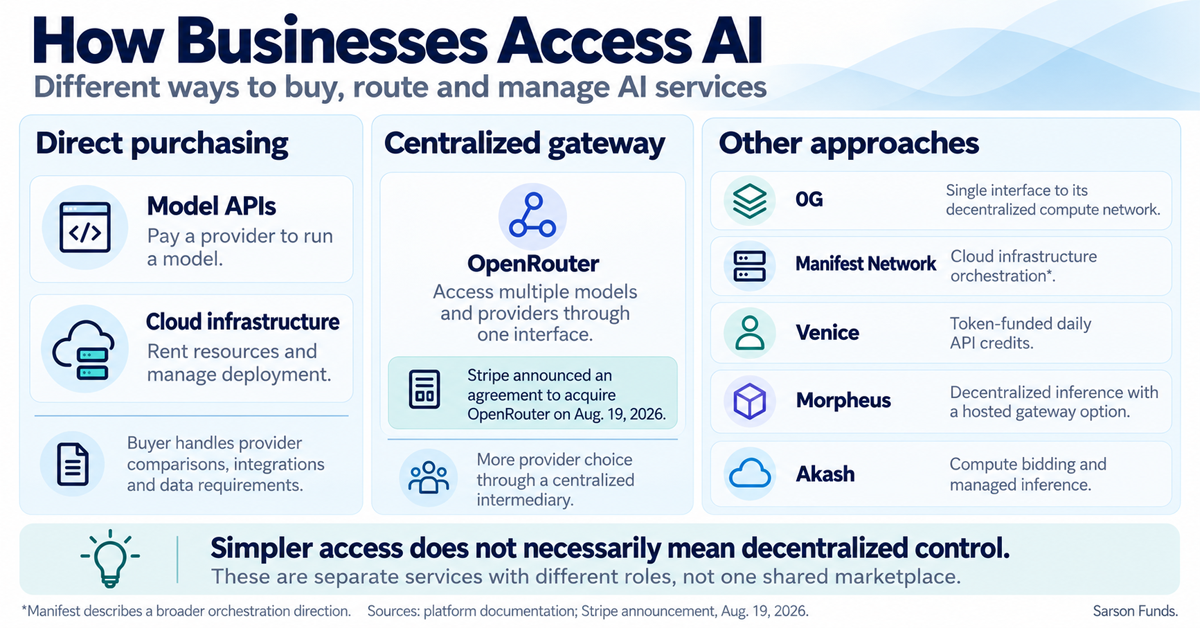
Businesses buying AI services generally face two options: pay a provider to use a model it operates, or rent computing resources and run models themselves. Those services are available through major cloud companies, specialized AI providers and decentralized networks. Together, they form today’s AI marketplace, but comparing them is difficult. Providers have different pricing structures and technical requirements, and switching services can mean rebuilding connections or reconsidering where business data will be processed.
The problem is not simply a shortage of computing power. It is the work required to find and use a service that fits. Routing software can help by connecting a request with an appropriate model or provider based on the customer’s requirements. OpenRouter, 0G, Manifest Network, Venice, Morpheus and Akash address different parts of that process. Their approaches offer a look at how buying and using AI could become easier, even though they do not form one unified marketplace.
How routing could improve the AI marketplace
OpenRouter provides a useful example of what simpler AI access can look like, and Stripe’s move to acquire it underscores the commercial importance of that role. Stripe announced the acquisition agreement on Aug. 19, citing OpenRouter’s ability to help businesses select models and manage token costs. OpenRouter brings models and inference providers behind a common interface, reducing the need for developers to build a separate connection to each service. Its routing system distinguishes between choosing a model and choosing the provider that runs it, with options to prioritize price, processing speed or response time. If a provider becomes unavailable, requests can fall back to another provider, while separately configured model fallbacks offer another level of flexibility. OpenRouter is a centralized gateway, not a decentralized compute network. It demonstrates how customers can gain access to more providers through a single intermediary, while leaving a separate question about who controls that access.
0G is applying a similar approach to its decentralized compute network, where computing resources come from distributed providers. According to its documentation, the 0G Compute Router gives developers a single connection and API key, then manages provider selection, authentication and blockchain-based billing. It can also switch providers when a request fails.
Morpheus also makes decentralized inference accessible through an OpenAI-compatible application programming interface, or API, allowing developers to connect familiar applications without running their own infrastructure. Its underlying marketplace connects consumers with model providers through smart contracts and routing software, while its managed API gateway offers a simpler entry point. That distinction matters: a convenient gateway can provide access to decentralized supply while remaining a centralized access layer itself. Akash adds another approach through competitive bidding for infrastructure and a separate managed inference service, AkashML. Together, these examples show different ways to make distributed computing resources easier to access.
Coordinating the infrastructure around AI
Manifest Network extends the discussion beyond selecting an AI model to coordinating the infrastructure around it. Its documentation describes a unified interface for computing resources, storage and Kubernetes deployments, which manage applications across servers. Its website describes an agent layer intended to orchestrate resources across conventional cloud providers and its own network.
That suggests a broader role for an AI marketplace: helping a business translate requirements into an appropriate deployment rather than simply finding the cheapest response to a prompt. An interactive assistant, a private document-processing system and a large training job have different needs. A useful orchestration layer would account for those differences, including location, hardware, storage and operational control, instead of treating all computing capacity as interchangeable.
Venice, whose ecosystem includes the VVV token, brings another dimension to the discussion: how customers fund access to AI. Venice allows users to lock staked VVV to mint DIEM tokens. Each staked DIEM provides $1 in daily Venice API credit. That credit is a service allowance, not a cash payment or a statement about the token’s market value.
This serves a different purpose from matching a workload with a computing provider, but it illustrates how access and payment can become part of the software experience. A broader routing system could eventually compare conventional pay-per-use services with token-funded allowances, directing eligible requests according to cost and available credit. That is a potential design, not evidence that all six platforms currently operate as one connected marketplace.
Lower costs still need clear requirements
Users need to be able to set clear requirements and have the system find eligible services without quietly compromising them. A cheaper route is not necessarily better if it changes the model, sends sensitive information somewhere unsuitable or introduces unreliable service.
A well-designed routing layer could reduce integration work and make it easier to switch between competing suppliers. It cannot manufacture scarce hardware or guarantee correct AI answers. Its value would depend on whether it makes decentralized infrastructure easier to use, with dependable access and costs customers can understand.
Disclosures: This article is for informational purposes only and should not be considered financial, legal, tax, or investment advice. It provides general information on cryptocurrency without accounting for individual circumstances. Sarson Funds, Inc. does not offer legal, tax, or accounting advice. Readers should consult qualified professionals before making any financial decisions. Cryptocurrency investments are volatile and carry significant risk, including potential loss of principal. Past performance is not indicative of future results. The views expressed are those of the author and do not necessarily reflect those of Sarson Funds, Inc. By using this information, you agree that Sarson Funds, Inc. is not liable for any losses or damages resulting from its use.