When Ondo Finance sent its December letter to the Securities and Exchange Commission, titled “Roadmap for Tokenized Securities,” the company was making a specific argument: tokenized securities should not be forced into a single market structure.
That argument now looks more relevant after SEC staff issued guidance outlining how federal securities laws apply to several tokenization models. The statement recognizes different structures, including issuer-sponsored tokenized securities and third-party-sponsored models that may include custodial or synthetic tokenized securities. That does not mean the SEC has endorsed any one company’s approach. But it does suggest that regulators are engaging with the same market-structure questions Ondo raised in its letter.
Ondo is a blockchain-based financial platform focused on bringing traditional financial assets, including U.S. Treasury and securities-linked products, onto public blockchain infrastructure. Its products sit at the intersection of traditional finance and decentralized finance, using blockchain rails to support issuance, transfer, settlement and potential collateral use.
That is why this moment matters. Ondo’s December letter was not simply a product pitch. It was part of a broader industry effort to define how tokenized securities can operate within U.S. securities laws. The recent SEC guidance brings that conversation closer to a workable regulatory framework.
Why the Letter Matters Now
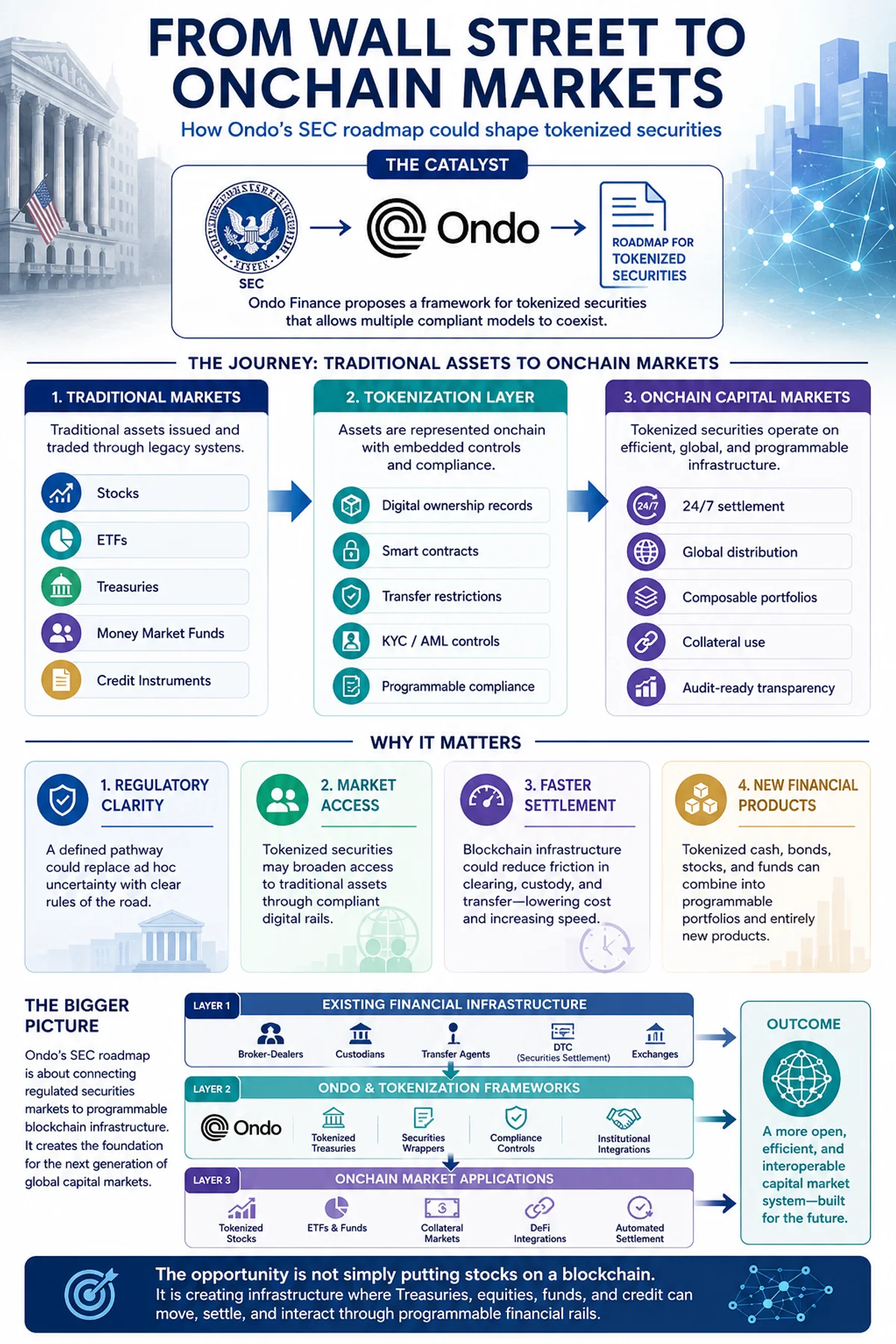
The importance of Ondo’s letter is that it focused on the practical architecture of tokenized markets. The question is no longer whether traditional securities can be represented onchain. They can. The harder question is how ownership, custody, transfer restrictions, disclosures, settlement and investor protections should work when securities move onto blockchain-based systems.
In plain terms, tokenized securities are traditional securities represented on a blockchain. A tokenized stock may provide a claim tied to an underlying equity, but the investor’s actual rights depend on how that product is structured. The SEC has emphasized that tokenization does not change the basic legal status of a security. Tokenized securities are still securities.
Ondo’s letter argued for flexibility across multiple compliant models, including direct and intermediated ownership structures, tokenization tied to securities held through existing market infrastructure and the use of permissioned, permissionless or hybrid blockchains. That is a more realistic framework than assuming one model will fit every issuer, exchange, broker-dealer or investor base.
The SEC Guidance Moves in the Same Direction
The SEC guidance is important because it appears to recognize that tokenized securities will not develop through one structure alone. Issuer-sponsored models, custodial models and synthetic exposure models raise different legal, operational and investor-protection questions. Treating them distinctly is a necessary step toward clearer rules.
That distinction is good for Ondo, but it is also good for the industry. It gives market participants a more precise vocabulary for discussing tokenized securities. It also helps separate legitimate tokenization from vague claims that putting an asset on a blockchain somehow changes the regulatory analysis.
The broader message is clear: tokenization may modernize market infrastructure, but it does not eliminate securities law. For credible RWA platforms, that is a constructive development. It rewards firms that have been building around compliance, custody, disclosures and institutional integration rather than treating regulation as an afterthought.
Why Ondo Is Well Positioned
Ondo stands out because its business model already reflects many of the assumptions behind regulated tokenization. Its tokenized U.S. Treasury and yield-bearing dollar products are designed to connect blockchain-based assets with know-your-customer and anti-money laundering processes, established custodians and institutional counterparties.
That gives Ondo a clearer role in the emerging market. The company is not just arguing that securities should move onchain. It has been building products around the idea that blockchain-based assets need a clear connection to offchain rights, regulated service providers and enforceable investor protections.
This is where the December letter becomes strategically important. Ondo laid out a framework before the latest guidance, and the SEC’s response now brings many of those same issues into the center of the policy conversation. That does not guarantee Ondo will be the primary winner, but it does put the company on the right side of the regulatory debate.
The Innovation Exemption as a Testing Ground
The discussion also fits into the SEC’s broader interest in an innovation exemption. Such an exemption could allow regulated venues and select crypto platforms to pilot trading in tokenized versions of traditional securities under a tailored, time-limited rule set.
The objective would not be to redefine what a stock is. Rather, it would test how stocks and other securities can operate on blockchain-based infrastructure, including wallets, smart contracts, 24/7 settlement, onchain order books and programmable compliance.
For market participants, this would be a meaningful shift. U.S. regulators appear to be moving from ad hoc guidance and enforcement-driven uncertainty toward more formal pathways for experimentation. If implemented carefully, an innovation exemption could give firms such as Ondo a framework to test tokenized securities while maintaining disclosure, reporting, custody and surveillance standards.
Broader Implications for Capital Markets
The larger story is not only about Ondo. If the SEC continues to clarify how tokenized securities fit within existing law, the opportunity set could expand well beyond Treasurys and yield-bearing dollars. Large-cap equities, exchange-traded funds and other registered securities could eventually move onto blockchain-based rails in a regulated format.
That would strengthen the case for onchain portfolios that combine tokenized cash, Treasurys, credit and equities in a single programmable structure. In this model, Ondo-style instruments could serve as the cash and bond foundation around which higher-beta tokenized exposures are built.
It would also increase the value of infrastructure that connects banking rails, broker-dealers, custodians, transfer agents and smart contracts. In a market where tokenized stocks and funds settle on the same chains, or on interoperable chains, the ability to move regulated value across systems becomes a competitive advantage.
The Bigger Market Structure Shift
Beyond Ondo, this development could support a broader wave of onchain market structure innovation. Tokenization platforms focused on equities and funds may gain a clearer compliance roadmap. Middleware providers offering KYC-gated wallets, transfer restrictions and audit-ready reporting could become essential components of compliant tokenized markets.
Oracles and attestation networks may also see greater demand for pricing, corporate actions and proof-of-reserves data. At the base layer, high-throughput blockchains, layer 2 networks and application-specific chains designed for capital markets could attract more interest from exchanges, broker-dealers and asset managers.
The news is significant because Ondo’s December letter and the SEC’s recent guidance are now part of the same policy arc. Ondo helped frame the questions. The SEC is beginning to answer them. If that process continues, tokenized securities could move from a niche crypto use case toward a more formal part of capital markets infrastructure.
Disclosures: This article is for informational purposes only and should not be considered financial, legal, tax, or investment advice. It provides general information on cryptocurrency without accounting for individual circumstances. Sarson Funds, Inc. does not offer legal, tax, or accounting advice. Readers should consult qualified professionals before making any financial decisions. Cryptocurrency investments are volatile and carry significant risk, including potential loss of principal. Past performance is not indicative of future results. The views expressed are those of the author and do not necessarily reflect those of Sarson Funds, Inc. By using this information, you agree that Sarson Funds, Inc. is not liable for any losses or damages resulting from its use.