
The CLARITY Act advanced out of the Senate Banking Committee in a bipartisan 15-9 vote, marking a meaningful step for U.S. digital asset policy, though the bill is not law yet. For digital asset investors, operators and allocators, the significance is straightforward: Congress is moving closer to a federal market structure framework rather than leaving much of the industry to a patchwork of enforcement actions, agency guidance and state-by-state rules.
What the CLARITY Act is
The Digital Asset Market Clarity Act of 2025, H.R. 3633, is a market structure bill designed to create a federal framework for digital assets. In plain terms, market structure refers to the rules that define who can issue, list, trade, custody and oversee financial assets.
In practical terms, the CLARITY Act is intended to answer basic but important questions: which agency regulates which activity, how token issuers and trading venues register, and what rules apply to secondary market trading.
For years, one of the central challenges in U.S. digital asset markets has been uncertainty over when a token is treated as a security, when it is treated more like a commodity, and which regulator has authority over trading activity. The CLARITY Act attempts to reduce that uncertainty by drawing clearer lines between the Securities and Exchange Commission and the Commodity Futures Trading Commission, while establishing rules for intermediaries and other market participants.
What happened this week
The Senate Banking Committee voted 15-9 to advance the bill, sending it out of committee and making it eligible for the next stage in the Senate process. That does not mean the bill becomes law automatically. It still needs Senate floor consideration, enough votes to pass the chamber, reconciliation with House language and the president’s signature.
Still, the vote was a notable step because it showed bipartisan support, with Democratic Sens. Ruben Gallego of Arizona and Angela Alsobrooks of Maryland joining Republicans in backing the measure in committee.
Prediction markets also reflected the change in sentiment. Polymarket’s “Clarity Act signed into law in 2026?” market rose from 59% on May 13 at 8 a.m. to roughly 69% to 70% after the Senate Banking Committee advanced the bill, suggesting traders saw higher odds that the bill could pass both chambers and become law this year.
Why market participants should care
At a high level, the CLARITY Act matters because market structure affects who can build, list, custody, trade and distribute digital assets in the United States. It has implications for exchanges, brokers, token issuers, custodians, stablecoin-related businesses, developers and investors allocating capital across the sector.
For institutions, builders, traders and other market participants, the issue is not lobbying or ideology. It is whether the U.S. is moving toward a clearer operating environment for compliance, product design, risk management and capital formation. Even before final passage, legislative progress can influence business planning as firms assess the contours of a possible future rulebook.
How CLARITY fits with GENIUS
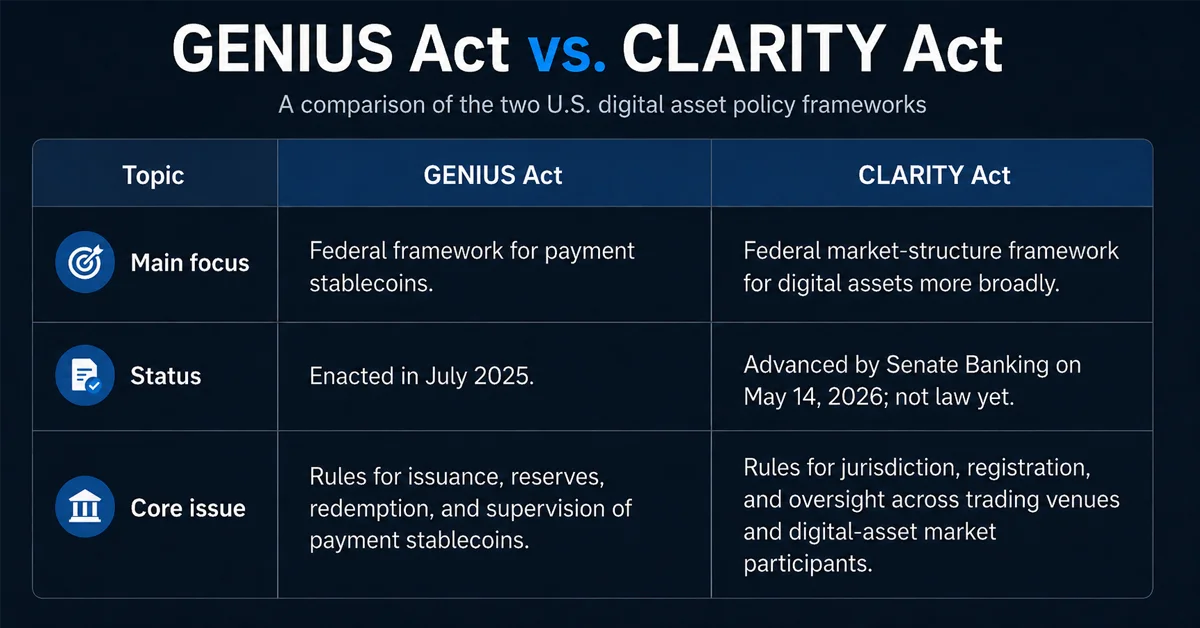
The CLARITY Act is not the only federal digital asset policy development in focus. The GENIUS Act, enacted July 18, 2025, established a federal framework for payment stablecoin activities and set standards around permitted issuers, reserves and redemption obligations.
The simplest way to understand the difference is this: GENIUS is primarily about payment stablecoins, while the CLARITY Act is broader market structure legislation for the digital asset ecosystem. Put another way, GENIUS addresses one important category of digital asset infrastructure, while CLARITY seeks to answer the larger question of how U.S. digital asset markets should be supervised overall.
What happens next
The next step is not automatic enactment. Senate leadership still has to bring the bill to the floor, the full Senate still has to pass it, and any Senate version must ultimately align with House language before a final bill can go to the president.
That means market participants should read this moment as progress, not closure. The legislative path is clearer than it was before the committee vote, but there is still a meaningful difference between clearing committee and becoming federal law.
The takeaway
The key development is straightforward: Washington is moving from broad debate toward more concrete digital asset legislation. For market participants, that matters because rules written through Congress are generally more durable and easier to interpret than policy made only through enforcement actions or ad hoc agency interpretation.
For now, the most useful posture is neither celebration nor alarm. It is close attention. The CLARITY Act is not finished, but it is now far enough along that investors, fund managers, traders, builders and other market participants should understand the broad outline of what Congress is trying to do and how it fits with the stablecoin framework already in place under GENIUS.
Disclosures: This article is for informational purposes only and should not be considered financial, legal, tax, or investment advice. It provides general information on cryptocurrency without accounting for individual circumstances. Sarson Funds, Inc. does not offer legal, tax, or accounting advice. Readers should consult qualified professionals before making any financial decisions. Cryptocurrency investments are volatile and carry significant risk, including potential loss of principal. Past performance is not indicative of future results. The views expressed are those of the author and do not necessarily reflect those of Sarson Funds, Inc. By using this information, you agree that Sarson Funds, Inc. is not liable for any losses or damages resulting from its use.