On Aug. 18, 2026, the Securities and Exchange Commission (SEC) formally proposed Regulation Crypto Assets, a new framework for certain investment contracts involving crypto assets. The proposal is the first major crypto-specific rule making under SEC Chairman Paul Atkins and is intended to provide a clearer, fit-for-purpose framework for capital formation in crypto markets.
The proposal arrived five days after the SEC canceled an Aug. 14 open meeting that had been scheduled to consider the rulemaking. The cancellation ultimately did not prevent the Commission from moving forward, putting a substantive framework on the table for token issuers and investors to evaluate.
Two New Exemptions for Crypto Offerings
At the center of Regulation Crypto Assets are two proposed exemptions from Securities Act registration.
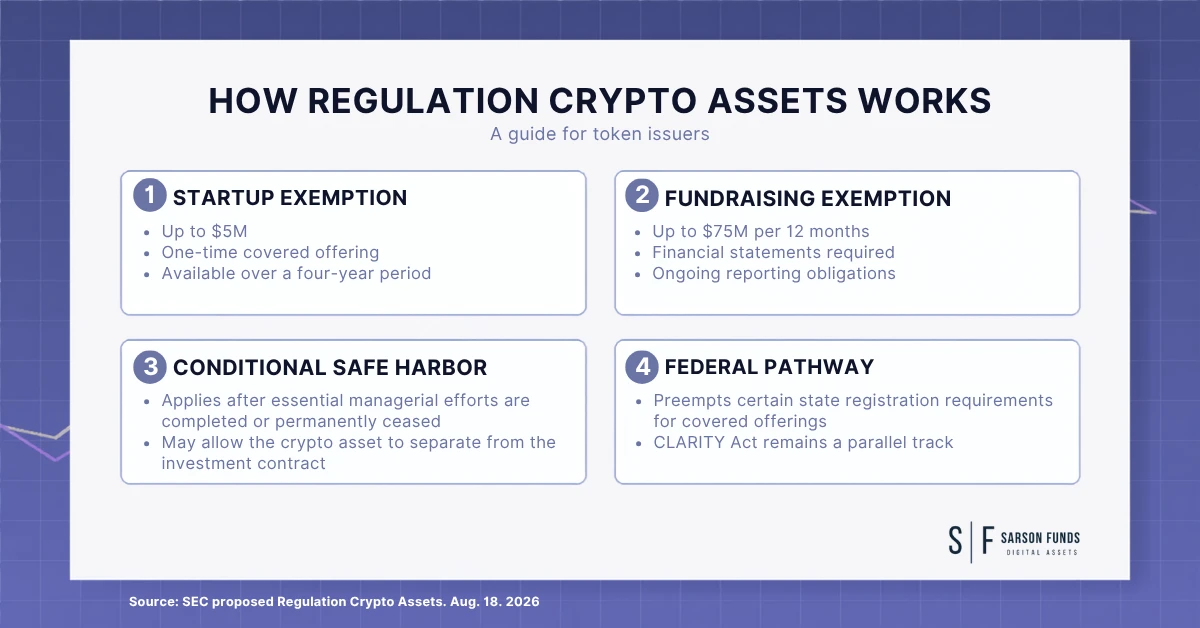
A startup exemption would allow an issuer to conduct covered transactions of up to $5 million during a period of no more than four years. A separate fundraising exemption, modeled on Regulation A, would establish two tiers for larger offerings. Tier 1 would permit offerings of up to $20 million, while Tier 2 would permit offerings of up to $75 million during any 12-month period, with additional financial statement and reporting requirements.
Both exemptions would require specified disclosures and remain subject to federal antifraud and anti-manipulation rules.
The structure borrows from familiar capital formation frameworks, including Regulation A. That is important because the SEC is not proposing a wholly separate securities regime for crypto. Instead, it is adapting established concepts to account for characteristics unique to crypto asset markets.
For token issuers, the result would be a lighter regulatory pathway than full registration, but not an exemption from securities law altogether.
The Conditional Safe Harbor
Potentially more consequential is the proposed conditional safe harbor addressing when a crypto asset can separate from the investment contract through which it was originally offered.
Under proposed Rule 400, an issuer could rely on the safe harbor after completing or permanently ceasing all of the “essential managerial efforts” it represented or promised to undertake, provided it does not make or intend to make new promises involving those efforts. The issuer also would file Form TR with the SEC containing a certification and supporting analysis. If the conditions are satisfied, the covered investment contract would be deemed to have ceased, and the underlying crypto asset would no longer be subject to that investment contract for purposes of the definitions of “security” under the Securities Act and Exchange Act.
In plain language, essential managerial efforts are the significant actions investors expect an issuer or development team to perform to make a project functional or successful. Once those promised efforts are completed or permanently ceased, the legal relationship between the issuer’s promises and the asset may change.
The concept has roots in Commissioner Hester Peirce’s earlier token safe harbor proposals. Peirce introduced the idea in 2020 and released an updated Token Safe Harbor Proposal 2.0 in 2021. Her framework contemplated a three-year development period followed by an analysis of network decentralization or functionality.
The current Regulation Crypto Assets proposal takes a different approach. Rather than requiring a specific three-year maturity period or separate decentralization test, it focuses on whether the issuer’s essential managerial efforts have been completed or permanently ceased.
That distinction is likely to become one of the central issues during the comment period. The safe harbor’s practical value will depend heavily on how regulators and market participants determine when those managerial efforts are complete and what evidence is sufficient to demonstrate that transition.
Rulemaking Provides Clarity, but Not Permanence
The safe harbor also carries an important structural limitation: It is being proposed through SEC rulemaking rather than enacted by Congress.
If adopted, the rule would carry substantially more legal weight than informal staff guidance or a commissioner statement. However, a future Commission could seek to amend or repeal it through another administrative process, and Congress could enact legislation that changes or supersedes portions of the framework.
For projects with development timelines measured in years, that distinction matters. The proposal may provide greater regulatory visibility, but it cannot eliminate future legislative, administrative or judicial changes.
State Preemption Could Be a Major Benefit
Another significant provision involves state securities laws.
The proposal would treat certain purchasers as “qualified purchasers” for purposes of Section 18 of the Securities Act. That would preempt state securities registration and qualification requirements for offerings conducted under the startup and fundraising exemptions, as well as certain secondary transactions involving covered investment contracts.
For issuers conducting offerings across multiple states, federal preemption could meaningfully reduce compliance complexity. Rather than analyzing registration or exemption requirements separately across numerous jurisdictions, qualifying issuers could operate under a more unified federal framework.
The proposal would not eliminate all forms of state authority. Its preemption provisions focus on registration and qualification requirements, so issuers should not interpret them as blanket immunity from state securities laws or enforcement.
The scope of this provision is worth watching closely, particularly as state securities regulators respond during the comment period.
How Regulation Crypto Assets Relates to CLARITY
The SEC rulemaking is advancing alongside a separate effort in Congress: the Digital Asset Market Clarity Act.
The House passed the CLARITY Act in 2025, and the Senate is now considering the legislation. A cloture vote on proceeding to the bill is scheduled for Sept. 15. That is a procedural step required before Senate debate can begin, not final passage.
For token issuers, the overlap creates an important planning question.
If Congress ultimately enacts comprehensive market structure legislation, portions of the SEC framework may need to be reconciled with the resulting statute. If legislation stalls, Regulation Crypto Assets could assume greater practical importance as the SEC develops a framework using its existing authority.
The two tracks therefore should be viewed as potentially complementary, but not interchangeable. One is agency rulemaking under existing law. The other could establish a statutory framework that is more difficult for future regulators to change.
What to Watch During the Comment Period
The implications for builders, issuers and investment funds are meaningful, but they are not immediate. The SEC proposal provides for a 60-day public comment period following publication in the Federal Register, after which the agency will consider comments before deciding whether to adopt, modify or abandon the proposal.
Several issues deserve particular attention:
-
- Essential managerial efforts: How the SEC interprets this standard will determine when issuers can realistically use the safe harbor.
- Safe harbor documentation: The proposed framework includes a process for notifying the SEC and the public that the conditions for separation have been satisfied.
- State preemption: Responses from state regulators could influence the final scope of federal preemption.
- CLARITY Act developments: Senate action will provide an important signal about whether a separate statutory market structure framework is likely to advance in 2026.
The Wider Regulatory Framework
Regulation Crypto Assets is only one component of a broader shift in U.S. digital asset regulation. Congress is considering market structure legislation, federal regulators are implementing the GENIUS Act’s stablecoin framework, and banking regulators continue to address digital asset business models through their supervisory and chartering authorities.
For token issuers, however, the SEC proposal directly addresses two longstanding questions: how certain crypto projects might raise capital under tailored federal exemptions and when a crypto asset may cease to be connected to an investment contract.
Those answers remain proposed, not final.
The industry has debated safe harbors for token development since Peirce introduced the concept in 2020. Regulation Crypto Assets is a significant attempt to translate portions of that debate into Commission-level rules.
Whether the framework survives the comment process largely intact, how it interacts with congressional legislation and how regulators ultimately interpret “essential managerial efforts” will be the issues worth watching next.
Disclosures: This article is for informational purposes only and should not be considered financial, legal, tax, or investment advice. It provides general information on cryptocurrency without accounting for individual circumstances. Sarson Funds, Inc. does not offer legal, tax, or accounting advice. Readers should consult qualified professionals before making any financial decisions. Cryptocurrency investments are volatile and carry significant risk, including potential loss of principal. Past performance is not indicative of future results. The views expressed are those of the author and do not necessarily reflect those of Sarson Funds, Inc. By using this information, you agree that Sarson Funds, Inc. is not liable for any losses or damages resulting from its use.