
Vitalik Buterin has put quantum-resistant blockchain security squarely on Ethereum’s agenda. Ethereum now has a dedicated post-quantum security team and a roadmap for replacing cryptography that sufficiently powerful quantum computers could eventually break.
That matters well beyond Ethereum.
Bitcoin, Solana, BNB Chain, Cardano, Algorand and other major networks are confronting versions of the same problem. Each can upgrade its own cryptography, but crypto users do not operate neatly within one chain. They hold assets across networks, use shared wallets and applications, and increasingly interact with infrastructure that spans ecosystems.
The question is therefore larger than whether any one blockchain can become quantum-resistant.
What happens when the entire digital asset economy has to make the transition?
What Quantum Could Actually Break
Blockchains rely heavily on public-key cryptography to establish ownership and authorize transactions. A sufficiently capable fault-tolerant quantum computer using Shor’s algorithm could eventually undermine elliptic curve cryptography used by networks including Bitcoin, Ethereum and Solana.
Such a machine does not exist today. The concern is that migration could take years, while the consequences of waiting too long could be severe.
Bitcoin illustrates the problem particularly well. Estimates cited by Forbes suggest millions of bitcoins are held in addresses whose public keys have already been exposed, representing hundreds of billions of dollars in value. Proposed responses include new quantum-resistant address types and, more controversially, eventually restricting legacy signatures that users fail to migrate. Those proposals remain under discussion, not adopted Bitcoin policy.
That is why the quantum problem is not simply about finding better mathematics. It is also about migration, governance and what happens to assets that cannot easily move.
How Major Blockchains Are Preparing
Different networks are already taking different approaches.
Ethereum is developing post-quantum upgrades across accounts, consensus and other parts of the protocol, with cryptographic agility as a core principle.
Solana has outlined a migration path that includes adopting a post-quantum signature scheme for new wallets and eventually migrating existing wallets if the threat becomes credible.
BNB Chain has gone further into performance testing. In 2026, it benchmarked transactions and consensus using ML-DSA post-quantum signatures, finding that migration was technically feasible but came with larger transactions and meaningful throughput trade-offs.
Algorand has already used Falcon signatures for quantum-resistant State Proofs and plans native post-quantum accounts, multisignature support and broader protocol protections as part of a roadmap targeting broad quantum resilience by 2027.
Cardano’s 2026 research roadmap similarly includes a post-quantum cryptography framework intended to allow vulnerable consensus primitives to be replaced with quantum-secure alternatives.
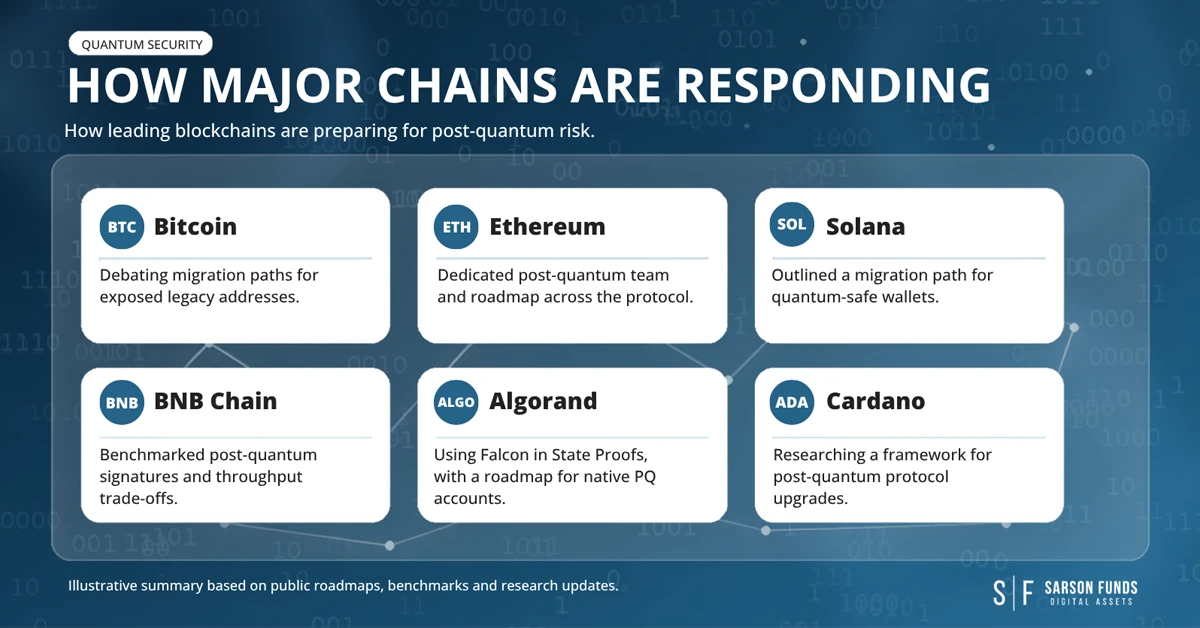
These are serious efforts. They also highlight the same structural issue: most approaches begin inside the individual chain.
The Problem With Solving Quantum One Chain at a Time
A quantum-resistant Ethereum does not automatically protect Bitcoin. A new Solana wallet standard does not migrate assets on another network. And even if every major Layer 1 succeeds independently, users may still have to navigate different wallet formats, migration procedures and security assumptions.
At the same time, quantum resistance is only one part of the security problem.
Users still copy long wallet addresses that are difficult to verify. Address-poisoning attacks exploit human behavior rather than broken cryptography. Public addresses can expose financial activity. AI agents may eventually execute transactions without a person manually checking every destination.
Future blockchain security therefore has to account for more than stronger signatures. It also has to consider privacy, human reliability and interoperability.
That raises a different question: Can some of those protections work across chains instead of being rebuilt independently inside each one?
A Multichain Approach
American Fortress has developed a multichain approach designed to protect existing wallets without requiring fund migration, addressing one of the most difficult operational problems in the industry’s post-quantum transition.
Its ZKPoSP architecture uses zero-knowledge proofs derived from a wallet’s original seed rather than requiring users to abandon their existing addresses. The company says the design is compatible with hierarchical deterministic wallets used across Bitcoin, Ethereum, Solana and other networks that rely on elliptic curve cryptography. A technical paper describing the system has been published to the Cryptography ePrint Archive, although it has not yet been peer-reviewed.
That distinction matters. Most network-level strategies involve introducing new signature schemes, new account types or eventual migration. American Fortress is addressing the wallet side of the problem with a layer intended to work across existing chains.
It is not the only company pursuing post-quantum wallet security. Freedom Factory, for example, has introduced PQ1, a hardware-wallet approach for Ethereum and other EVM-compatible networks using post-quantum signatures and smart accounts. Bitcoin-focused projects, Algorand, the Quantum Resistant Ledger, BTQ and others are also pursuing quantum resilience from different angles.
The distinction is architectural rather than categorical: American Fortress is focused on preserving existing wallet addresses across multiple chains without requiring users to move funds.
That approach is also moving beyond a white-paper concept. Casper is integrating American Fortress technology around quantum protection, privacy and regulated assets; its Litecoin work combines MWEB privacy with FortressNames and dynamic addressing; and its collaboration with 0G applies related infrastructure to transactions conducted by AI agents.
Those integrations address different use cases, but the common thread is portability.
There Is Probably No Single Quantum Fix
The industry’s answer is unlikely to be one technology.
Bitcoin, Ethereum, Solana and other networks will still need to strengthen their underlying protocols. Post-quantum signature standards will continue to evolve. Wallets and account systems will need better migration paths. Privacy and identity infrastructure will have to improve alongside cryptography.
The broader lesson is that quantum-resistant blockchain security has at least two layers: securing each blockchain and securing the users and infrastructure that move between them.
Vitalik Buterin’s push toward a quantum-safe Ethereum is an important part of that transition. So are Bitcoin’s migration debates, BNB Chain’s testing, Algorand’s roadmap and the work underway across other major ecosystems.
American Fortress adds another piece: a multichain security layer designed around wallets that already exist.
The quantum era may require both approaches.
Individual chains can protect themselves. The harder challenge is protecting everything that connects them.
Disclosures: This article is for informational purposes only and should not be considered financial, legal, tax, or investment advice. It provides general information on cryptocurrency without accounting for individual circumstances. Sarson Funds, Inc. does not offer legal, tax, or accounting advice. Readers should consult qualified professionals before making any financial decisions. Cryptocurrency investments are volatile and carry significant risk, including potential loss of principal. Past performance is not indicative of future results. The views expressed are those of the author and do not necessarily reflect those of Sarson Funds, Inc. By using this information, you agree that Sarson Funds, Inc. is not liable for any losses or damages resulting from its use.