
The crypto market is entering a more difficult macro and policy environment. Bitcoin has remained relatively resilient, spot Bitcoin ETFs continue to be an important institutional demand channel, and stablecoins remain central to crypto-market liquidity.
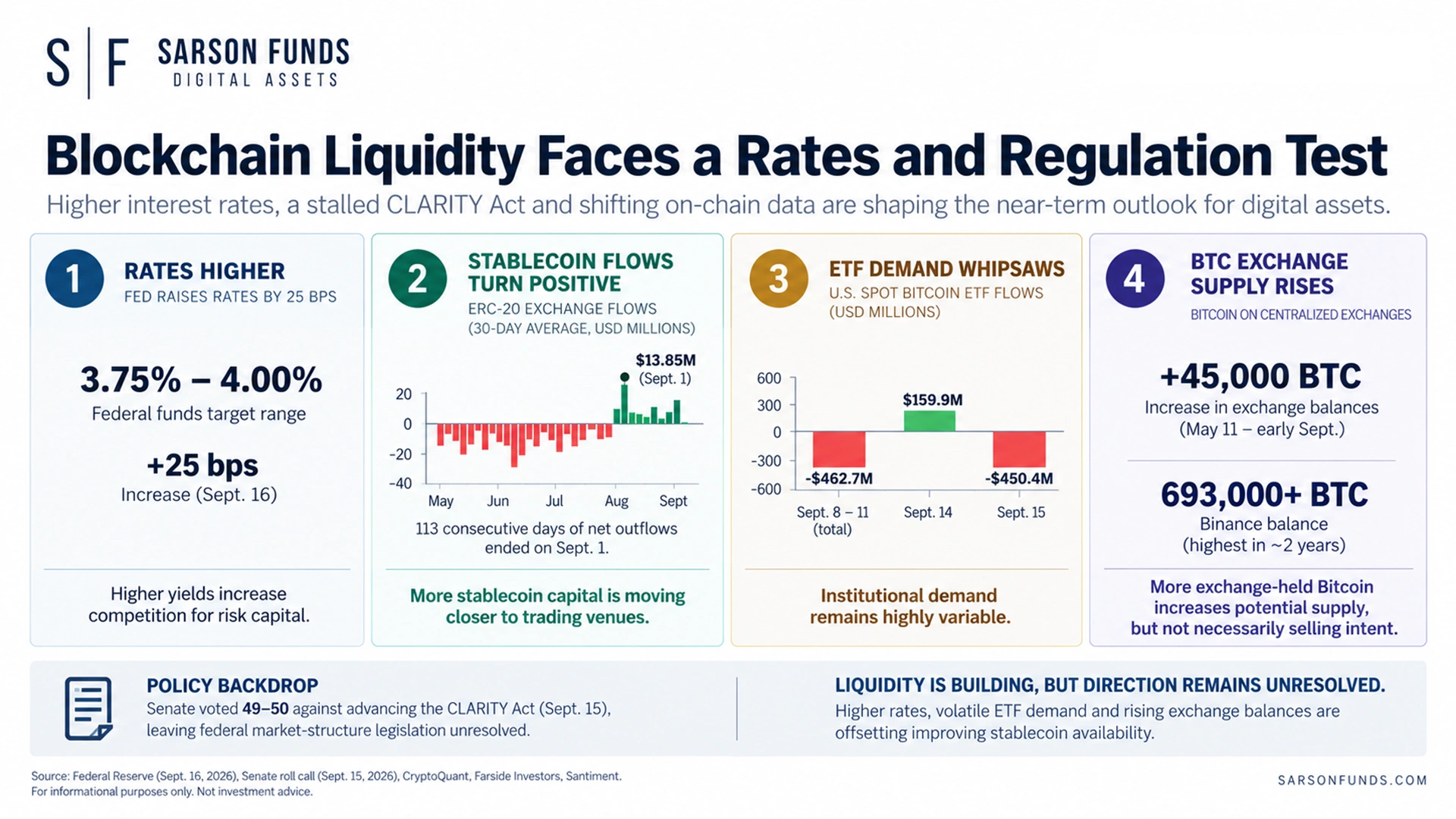
But two developments now shape the near-term backdrop: the Federal Reserve raised its benchmark rate by 25 basis points to 3.75%–4.00%, while the Senate failed to advance the CLARITY Act on Sept. 15. Higher rates can weigh on demand for non-yielding risk assets, and the failed vote extends uncertainty around U.S. crypto market structure.
That does not establish a bearish outcome. Stablecoin flows toward exchanges suggest some capital is becoming more readily deployable. The market is better characterized as positioned for a larger response, with the direction likely to depend on whether institutional demand and broader risk appetite improve or deteriorate.
Stablecoin Flows Turn Positive
On Sept. 1, the 30-day average net flow of ERC-20 stablecoins to exchanges turned positive after 113 consecutive days of net outflows. The measure reached about $13.85 million before declining to $11.66 million on Sept. 2 and $6.85 million on Sept. 3.
The shift matters, but it is not confirmation that capital is being deployed into Bitcoin or other digital assets. Stablecoins moving onto exchanges may be used for derivatives collateral, arbitrage, market making or transfers between venues.
Still, capital held on an exchange is generally more available for trading. In a higher-rate environment, that liquidity may reflect readiness to trade or hedge rather than a direct commitment to spot-crypto accumulation.
Rates and Policy Add Headwinds
The Federal Reserve’s 25-basis-point rate increase to 3.75%–4.00% reinforces that financial conditions remain restrictive. Higher cash and government-bond yields can raise the opportunity cost of holding volatile, non-yielding assets such as Bitcoin. That makes sustained ETF and spot demand more important to the bullish case.
The policy picture also weakened after the Senate rejected cloture on the motion to proceed to the CLARITY Act by a 49–50 vote, below the 60 votes required. The bill sought to create a comprehensive framework for digital-asset market structure and oversight by the SEC and CFTC.
The failed vote does not create an immediate new restriction on crypto activity. It does, however, delay clearer federal rules for exchanges, issuers, custodians and institutions. Until Congress revisits the issue, the industry remains subject to existing agency authority, court decisions and fragmented regulatory approaches.
Rising Bitcoin Balances Require Context
Bitcoin held on centralized exchanges increased by roughly 45,000 BTC between May 11 and Sept. 8, according to Santiment data. Binance’s Bitcoin balance also climbed above 693,000 BTC by early September, its highest level in about two years.
Rising exchange balances can appear bearish because more Bitcoin is theoretically available for sale. However, reserves can increase for reasons unrelated to selling. Binance’s conversion of its $1 billion SAFU fund into Bitcoin, as well as reported transfers from self-custody following concerns around the Coldcard hardware-wallet incident, can raise reported balances without signaling immediate selling pressure.
Exchange balances should therefore be viewed as potential supply, not proof of intent. They become more meaningful when they rise alongside weakening spot demand, persistent ETF outflows and higher volatility.
ETF Activity Remains Critical
Exchange data captures only part of the market. Spot Bitcoin ETFs can source Bitcoin through over-the-counter transactions rather than public exchange addresses, and ETF flows can change quickly with broader market sentiment.
U.S. spot Bitcoin ETFs recorded approximately $462.7 million in net outflows during the four trading sessions from Sept. 8 through Sept. 11, following nearly $987 million of inflows the previous week. That reversal shows why no individual on-chain metric should be treated as a standalone market signal.
With rates now higher and legislation delayed, ETF demand is likely to remain one of the clearest measures of whether institutional investors are willing to add crypto exposure.
Low Volatility Raises the Stakes
Bitcoin’s one-month realized volatility has approached historically low levels, while roughly 71% of circulating supply was estimated to be in profit. Long-term holder behavior may be limiting active supply and helping suppress volatility.
Low volatility does not predict timing or direction. It does mean that liquidity shifts can matter more if market activity begins to accelerate. Stablecoin inflows, ETF flows, exchange balances and broader risk conditions should be watched together rather than in isolation.
Watching for Convergence
The current market has both constructive and negative elements. Stablecoin capital is moving closer to exchanges after a long period of outflows, but rates are higher, ETF demand has been volatile and U.S. market-structure legislation has stalled.
A more constructive signal would be sustained stablecoin inflows to exchanges alongside renewed ETF inflows, stronger spot activity and improving risk appetite. A weaker setup would include renewed stablecoin outflows, continued ETF redemptions, exchange-balance increases tied to active selling or tighter financial conditions.
For now, crypto appears increasingly prepared to react, but not decisively positioned for a specific outcome.
Disclosures: This article is for informational purposes only and should not be considered financial, legal, tax, or investment advice. It provides general information on cryptocurrency without accounting for individual circumstances. Sarson Funds, Inc. does not offer legal, tax, or accounting advice. Readers should consult qualified professionals before making any financial decisions. Cryptocurrency investments are volatile and carry significant risk, including potential loss of principal. Past performance is not indicative of future results. The views expressed are those of the author and do not necessarily reflect those of Sarson Funds, Inc. By using this information, you agree that Sarson Funds, Inc. is not liable for any losses or damages resulting from its use.