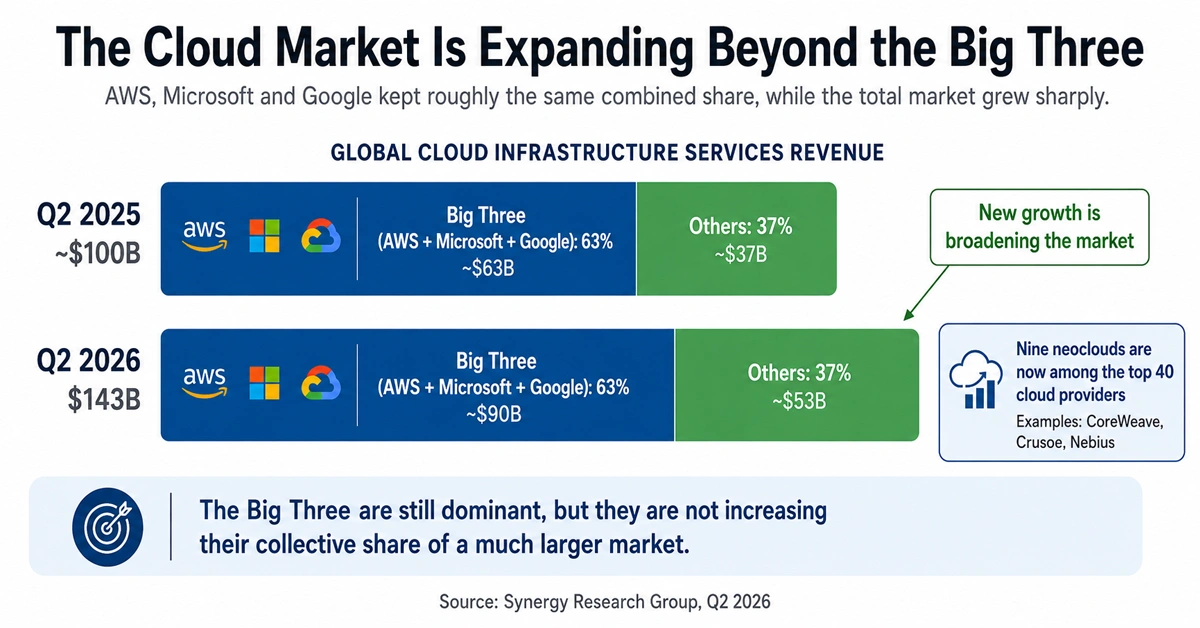
Only a year ago the mainstream narrative around the global AI buildout was almost entirely about hyperscalers: Amazon Web Services, Microsoft Azure or Google Cloud. Those three centralized providers account for roughly 63% of the global cloud infrastructure market. The prevailing assumption was that explosive AI demand would further concentrate compute inside the Big Three.
Data from Synergy highlights a significant shift. The global cloud infrastructure market has doubled in size over the past 11 quarters, with GenAI serving as the primary driver. Yet Amazon, Microsoft and Google still hold about 63% of the market – basically unchanged from a year ago. So Yes, the hyperscalers are indeed growing rapidly, but they’re not increasing their collective share of an expanding market. At the same time, emerging “neocloud” entities like CoreWeave, Crusoe, and Nebius are among the industry’s fastest-growing players, with nine neoclouds now ranked in the top 40 globally.
Examining Sovereignty
Sovereign AI is increasingly prominent in mainstream coverage, but more often than not it’s discussed as a national or state government issue. At its core, sovereignty is about retaining meaningful control over compute, data, models, access and governance.
National sovereignty is the most visible trend in the sovereignty narrative because governments want AI infrastructure that sits in their own jurisdiction, landing squarely into its own domestic laws, and they don’t want to be fully reliant on hyperscalers.
NVIDIA just released its quarterly earnings report, and it’s pretty clear that sovereign infrastructure has gone from a policy idea to a substantial commercial category. They reported 35% quarter over quarter growth and more than tripled year over year.
That same underlying desire for control, privacy and resilience exists outside government. Enterprises need to protect sensitive workloads, operators want to retain ownership of their hardware and their capacity, and users want more control over how their data is processed now more than ever.
So sovereignty doesn’t necessarily require State or National boundaries, or involve any single government. A system can be globally distributed and still preserve control. Once control becomes the defining issue, questions of geography, jurisdiction, ownership, power, resilience, and interoperability all become much more important.
It’s a Sensitive Subject
If sovereignty is ultimately about retaining control, it begs the question: who can access the data, models and infrastructure?
Sovereignty doesn’t require a decentralized architecture. A state entity could deploy a strictly centralized domestic AI infrastructure, maintained within its geography and governed by its internal authority. In that case we’d be satisfying the requirements of national sovereignty while remaining completely centralized. While this model fulfills the requirements of national sovereignty, it remains fundamentally centralized in its operational design.
In the same vein, decentralization does not guarantee sovereignty. A protocol might disperse its processing power among numerous providers, but remain tethered to unified governance models or centralized orchestration layers. A truly distributed system still doesn’t equate to the autonomy or resilience needed for actual sovereignty.
So the more interesting question seems to be: Where does control actually reside? In a sovereign system, that control might sit with a state, enterprise, operator or individual. A decentralized system distributes control to varying degrees, but the architecture alone does not determine who ultimately governs access to the data, models and infrastructure.
Geography Matters, and It’s Not Just About Latency Anymore
Where AI infrastructure is physically located matters because geography often determines which laws govern the data, who can compel access to it, and what regulatory obligations apply.
Location alone doesn’t equate to sovereignty. Infrastructure might sit inside one country while remaining owned or administered by a foreign entity. This is why a government or enterprise may use a hyperscaler region located domestically, but that doesn’t necessarily resolve every question around ownership, legal jurisdiction, administrative access or dependency on a foreign platform: geography is becoming a design variable in AI infrastructure, not just a latency consideration.
Land and Power
The connection to the Bedrock thesis is perhaps most profound here. NVIDIA is increasingly framing AI infrastructure in physical terms, with nations and regions dedicating land and energy to local compute operators.This shift redefines what once appeared to be a specialized real estate niche into a fundamental stake in a burgeoning global infrastructure asset class.
The Physical Layer
While AI experiences often feel purely digital, the underlying infrastructure is fundamentally material. Processing power remains tethered to the availability of land, energy, thermal management, and specialized facilities designed to house high-density hardware configurations.
NVIDIA’s latest sovereign AI figures underscore this reality. Growth in this sector is increasingly tied to governments and regional entities dedicating their land and power to local compute, turning AI infrastructure into a tangible strategic asset. Expansion in this sector is increasingly defined by state actors and regional authorities dedicating domestic land and power resources to cultivate local compute capabilities, effectively transforming AI hardware into a vital strategic asset.
There’re a growing number of companies approaching this shift from different angles, from neoclouds and decentralized GPU networks to localized sovereign infrastructure. Two initiatives in our immediate orbit show how these distinct layers of the AI stack can successfully interoperate.
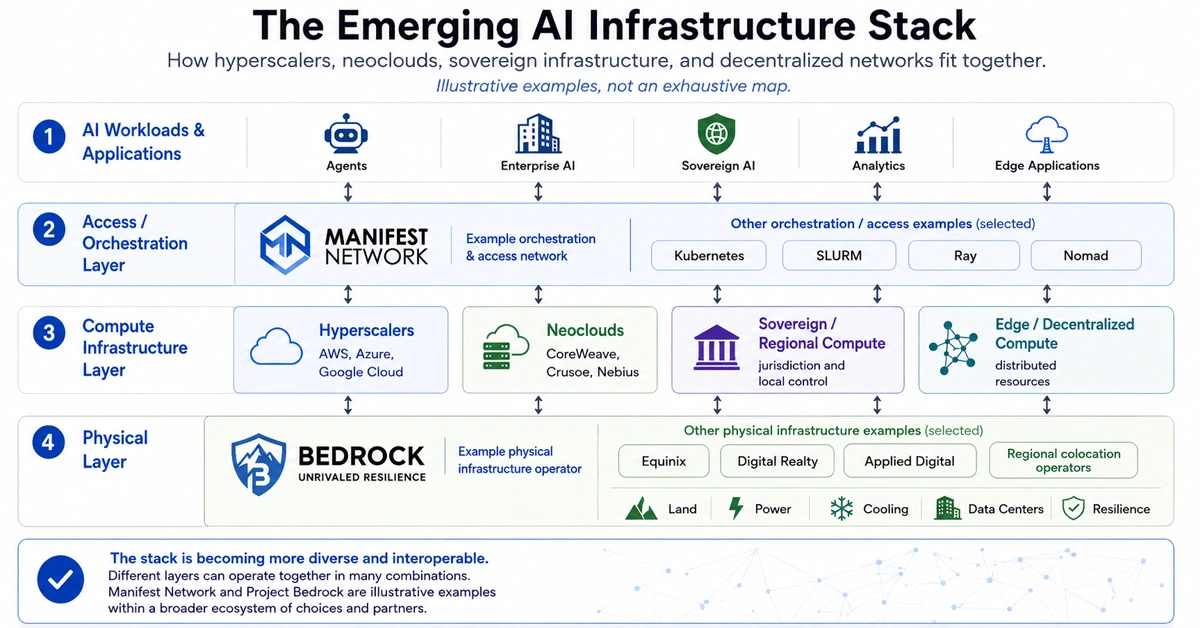
Project Bedrock addresses that physical layer through hardened facilities built to support resilience. Simultaneously, Manifest Network then makes up the networking layer, connecting independently controlled compute resources without concentration like we see inside a single hyperscaler.
The point is not that hyperscalers are on the decline, the market is simply diversifying. Centralized cloud providers, sovereign infrastructure, neoclouds, edge systems and decentralized networks are all developing alongside one another.
Disclosures: This article is for informational purposes only and should not be considered financial, legal, tax, or investment advice. It provides general information on cryptocurrency without accounting for individual circumstances. Sarson Funds, Inc. does not offer legal, tax, or accounting advice. Readers should consult qualified professionals before making any financial decisions. Cryptocurrency investments are volatile and carry significant risk, including potential loss of principal. Past performance is not indicative of future results. The views expressed are those of the author and do not necessarily reflect those of Sarson Funds, Inc. By using this information, you agree that Sarson Funds, Inc. is not liable for any losses or damages resulting from its use.