DTCC’s launch gives financial firms a working way to move securities on a blockchain. The practical benefits may reach investors before the technology becomes visible to them.
Buying a stock takes a few taps. Behind that purchase, financial institutions still have to deliver the shares and update the records showing who owns them. On Oct. 28, the DTCC Tokenization Service went live, giving participating firms a blockchain-based way to move securities already held in the financial system. Twenty firms have signed agreements to use it, including JPMorgan, Citi, Morgan Stanley, Bank of America, Fidelity and UBS.
In Tokenized Stocks Are Real. Now Companies Want a Say., we described DTCC’s service as scheduled for October. A day after publication, it launched. That changes the discussion: financial firms now have a service they can begin incorporating into their operations, with actual usage becoming the next measure of progress.
What a “digital twin” share actually represents
DTCC helps handle the work that follows a securities trade. Its subsidiary, the Depository Trust Company, or DTC, holds securities on behalf of participating financial institutions.
The new service lets eligible firms create a blockchain-based representation of their rights to securities held at DTC. DTCC calls these tokens “digital twins.” They can be converted between traditional and tokenized forms while retaining the underlying ownership rights and economic benefits.
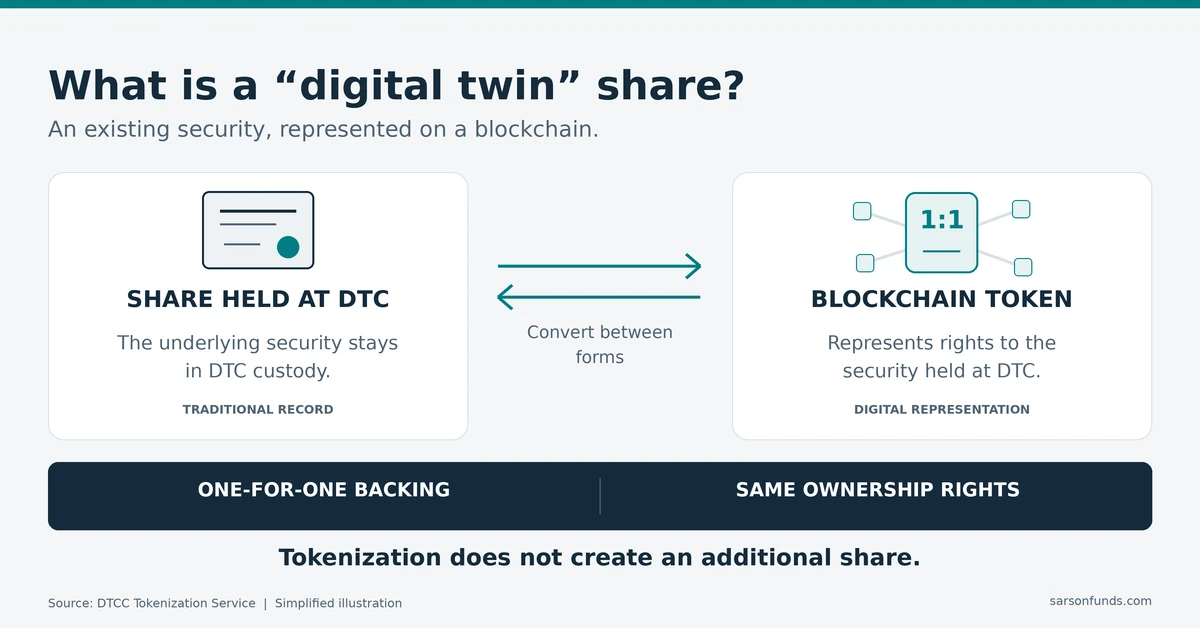
For a stock, the basic idea is straightforward: an existing share supports a token that can move through an approved blockchain network. Creating that token does not mean the company has issued another share. The token represents an interest in a security already held in custody, with one-for-one backing.
That distinction connects directly to our earlier article. Some products called stock tokens only provide exposure to a share’s price. Understanding what the holder legally owns remains essential, even when the technology makes the products look similar.
The DTCC Tokenization Service initially covers 34 securities, including selected stocks, ETFs and U.S. Treasuries. A DTCC spokesperson told CoinDesk that the eligible securities represent roughly $30 trillion in market value. That is the size of the eligible pool, not an announcement that $30 trillion has already moved onto blockchains.
Why moving securities after hours matters
The immediate benefit is easier movement of assets. DTCC says tokenized securities can transfer around the clock between registered wallets on the same supported network. That does not automatically create a stock market where everyone can buy and sell at any hour. It gives participating institutions more flexibility over when they deliver assets to one another.
Consider a firm that needs to pledge Treasury securities as collateral, meaning assets set aside to secure an obligation. If those securities can reach an approved recipient sooner, the firm may have less need to borrow cash or keep extra funds available while it waits. The benefit depends on the recipient accepting the assets and having systems that can process them.
There are still operating limits. CoinDesk reports that converting securities into tokens takes place during business hours, while subsequent transfers can occur around the clock. Tools for settlement using digital cash are also part of the development roadmap. Faster securities transfers are useful, but completing a transaction requires the payment side to work as well.
For individual investors, the first changes may happen inside their broker’s operations. Whether those improvements eventually mean lower costs or more flexible services will depend on how firms use them.
Google sees a business in protecting digital assets
Moving securities on a blockchain creates another practical responsibility: protecting the credentials that authorize transfers. In digital-asset custody, a private key serves that purpose. Someone who gains control of the necessary signing credentials may be able to move the assets.
Google is developing a service to help financial institutions manage that risk. Its Multi-Party Compute product combines shared transaction signing with controls such as spending limits and approved destinations. Instead of relying on one system to authorize a transfer, an institution can require several participants to work together.
According to CoinDesk’s Oct. 28 report, the service is in private preview, with commercial availability planned for early 2027. Alphabet is already using it to protect digital assets on Ethereum and Solana, although Google did not identify the specific assets. Financial institutions are also testing the technology.
The business case is understandable. Banks that offer digital-asset services need security they can fit into their existing approval procedures. Google has an opportunity to sell that infrastructure to institutions already accustomed to buying cloud services.
This builds on the trend we described in Big Brands Are Building a More Familiar Way Into Crypto. Adoption becomes more practical when businesses can use technology through providers and processes they already understand.
Ripple adds federal oversight to its custody plans
Earlier in the week, on Oct. 26, Ripple announced final approval from the Office of the Comptroller of the Currency to establish Ripple National Trust Bank.
The approved activities include managing reserves supporting its dollar-linked RLUSD stablecoin and providing digital-asset custody services under fiduciary obligations. RLUSD will continue to be issued by Ripple’s New York-regulated Standard Custody & Trust Company. The national trust bank adds federal supervision to that structure.
This is a limited trust-bank charter, not a full-service commercial banking license. Its relevance here is the regulated framework for holding assets and administering reserves, work that institutions need regardless of which blockchain they use.
DTCC’s launch makes the most immediate change. Google’s preview and Ripple’s approval address supporting needs at different stages of readiness. Still, none of those things establish how quickly customers will actually adopt the services.
The DTCC Tokenization Service now gives firms something concrete to evaluate. Can they move collateral sooner? Does it reduce the work required to reconcile ownership records? Those results will tell investors more about blockchain’s usefulness than the size of the eligible asset pool alone.
Disclosures: This article is for informational purposes only and should not be considered financial, legal, tax, or investment advice. It provides general information on cryptocurrency without accounting for individual circumstances. Sarson Funds, Inc. does not offer legal, tax, or accounting advice. Readers should consult qualified professionals before making any financial decisions. Cryptocurrency investments are volatile and carry significant risk, including potential loss of principal. Past performance is not indicative of future results. The views expressed are those of the author and do not necessarily reflect those of Sarson Funds, Inc. By using this information, you agree that Sarson Funds, Inc. is not liable for any losses or damages resulting from its use.