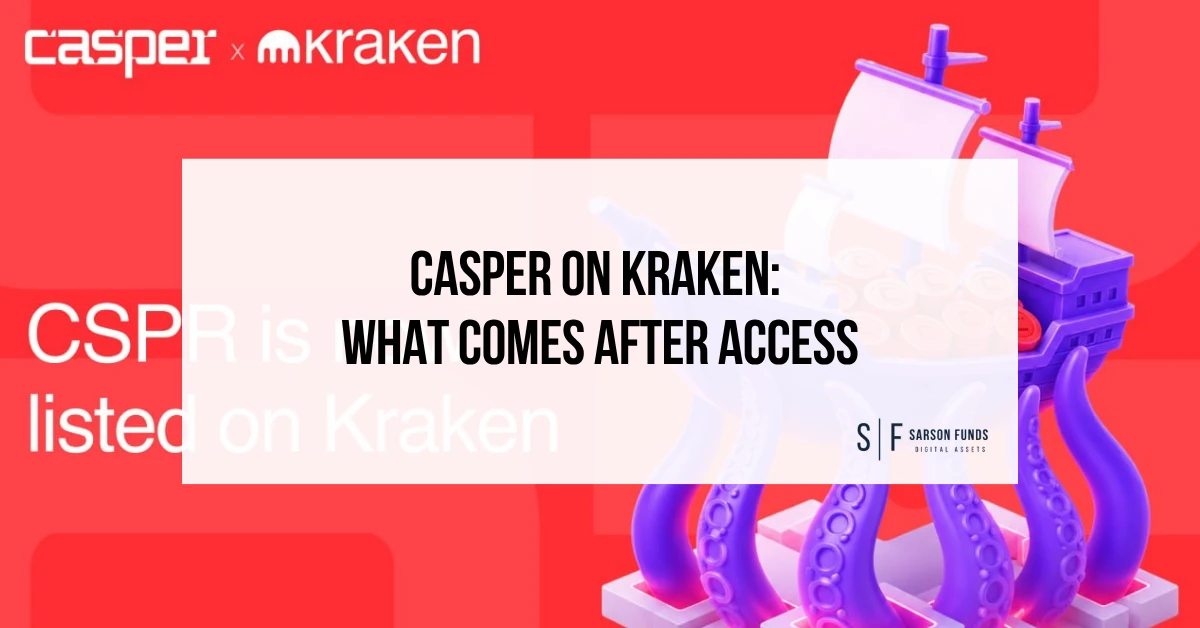
Casper on Kraken is now a reality. With CSPR available for trading on the platform, U.S.-based participants have a more familiar way to access the asset and begin exploring the network behind it. The listing resolves one of Casper’s longstanding challenges in the U.S. market: limited access.
That distinction matters. Technology, development activity and long-term strategy can only attract so much attention when market participants face practical barriers to acquiring an ecosystem’s native asset. Kraken’s support for CSPR does not change Casper’s underlying technology, but it may change how many people are willing and able to examine it.
The question is no longer when broader access will arrive. It is what participants do with that access.
From Market Access to Network Discovery
Casper is a proof-of-stake Layer 1 blockchain focused on regulated real-world assets, or RWAs, enterprise applications, staking and machine-native commerce. A Layer 1 is the underlying blockchain infrastructure on which applications, transactions and digital assets operate.
CSPR supports activity across the network, including transaction fees, staking and validator rewards. Although many users may first encounter Casper through its token, the network’s broader relevance depends on the infrastructure and applications being developed around it.
Casper has emphasized upgradeable smart contracts, predictable network operations and tools intended to support compliant on-chain activity. Its development roadmap also addresses areas such as institutional controls, consumer usability, privacy, micropayments and autonomous machine-to-machine transactions.
These capabilities existed before Casper on Kraken. The listing matters because it creates a more direct path for U.S.-based participants to discover and evaluate them.
A Timely Focus on RWAs and Machine Commerce
Casper’s expanded access comes as financial and technology companies continue exploring tokenization, RWAs and blockchain-based systems that can support activity beyond digital asset trading.
RWA tokenization refers to representing ownership or rights associated with assets, such as securities, funds or other financial instruments, on a blockchain. Machine-native commerce describes systems in which connected devices or artificial intelligence agents can initiate and settle transactions with limited human involvement.
Both areas require more than transaction capacity. Institutional adoption may also depend on predictable costs, compliance features, application flexibility and infrastructure that can adapt as business and regulatory requirements evolve.
Casper is positioning its technology around those needs. That does not guarantee adoption, nor does it require presenting Casper as the largest Layer 1 network. The more relevant development is that market participants now have fewer access barriers when evaluating whether Casper’s approach is useful for their applications.
Access Is the Beginning, Not the Outcome
A centralized exchange listing can improve visibility and accessibility, but it does not by itself create lasting network participation. The next phase depends on whether new users move beyond the ticker and learn how the ecosystem operates.
That includes understanding staking, delegation and validators. Validators process transactions and help secure a proof-of-stake blockchain. Delegation allows token holders to assign their stake to a validator and participate in the staking process without operating their own validator infrastructure.
Sarson Funds recently launched a U.S.-based Casper validator as part of its broader work around staking access and digital asset education. With Casper on Kraken, that educational effort becomes increasingly relevant. More participants can now access CSPR, but informed participation also requires an understanding of network mechanics, validator selection and the risks associated with digital assets and staking.
Kraken’s listing represents a meaningful access and visibility milestone for Casper. Its longer-term importance will depend on what follows: deeper ecosystem research, greater network participation and continued development around real-world applications.
For U.S.-based participants who previously had limited ways to engage with Casper, the opportunity to begin that evaluation is now more accessible.
Disclosures: This article is for informational purposes only and should not be considered financial, legal, tax, or investment advice. It provides general information on cryptocurrency without accounting for individual circumstances. Sarson Funds, Inc. does not offer legal, tax, or accounting advice. Readers should consult qualified professionals before making any financial decisions. Cryptocurrency investments are volatile and carry significant risk, including potential loss of principal. Past performance is not indicative of future results. The views expressed are those of the author and do not necessarily reflect those of Sarson Funds, Inc. By using this information, you agree that Sarson Funds, Inc. is not liable for any losses or damages resulting from its use.