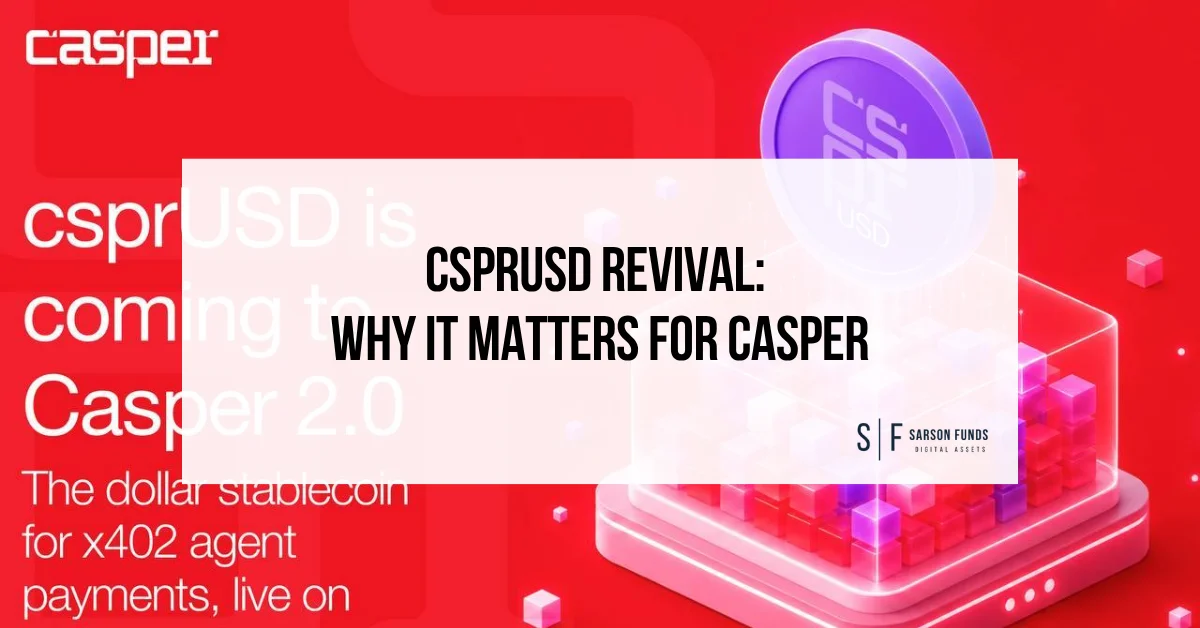
The csprUSD revival could add an important piece of financial infrastructure to the Casper ecosystem. Casper Association and Sarson Funds announced on July 29 that csprUSD, a U.S. dollar stablecoin originally launched in 2024, is being upgraded for Casper 2.0 and Casper’s emerging machine-payment infrastructure. The upgraded stablecoin is expected to reach Casper Mainnet later in the third quarter of 2026, subject to testnet validation, a security audit and regulatory compliance requirements.
Rather than functioning as another general-purpose digital asset, csprUSD is being positioned as Casper’s standard stablecoin settlement asset. Its intended uses include application payments, decentralized finance, liquidity and payments initiated by autonomous software.
Why Stable-Value Infrastructure Matters
Many blockchain applications are easier to use when transactions can be denominated in a stable-value asset instead of a volatile network token. Payments, trading pairs, treasury management and tokenized real-world asset activity can become more understandable when users know the approximate dollar value being transferred.
CSPR will continue to serve as Casper’s native token for network operations, including transaction fees and staking. However, csprUSD could provide a separate settlement asset for applications that require dollar-denominated payments or accounting.
This distinction is important. The csprUSD revival does not replace CSPR or eliminate the need for the network’s native token. Instead, it is designed to expand the types of financial activity that developers can build on Casper.
Connecting csprUSD to x402 Payments
A central part of the announcement is the planned connection between csprUSD and x402, an internet payment protocol based on the HTTP 402 “Payment Required” status code. In plain language, x402 allows a website or online service to request and receive payment as part of a standard internet request.
This model could be useful for artificial intelligence agents and other automated systems. Instead of completing a credit card form or maintaining a conventional subscription, software could authorize an individual payment for an application programming interface call, data request or computing service.
Casper has developed x402 infrastructure that allows these payment instructions to be settled on-chain. According to the announcement, an x402 facilitator is live on Casper Mainnet, while developers can use Casper’s testnet environment to build and test payment flows.
The upgraded csprUSD contract is expected to implement CEP-3009, Casper’s standard for authorized token transfers. CEP-3009 allows a tokenholder to sign a payment authorization off-chain so that another party, such as an x402 facilitator, can submit and settle it on-chain.
This structure is intended to support payments without requiring an AI agent or user to submit every blockchain transaction directly.
Supporting Lower-Value Machine Payments
Transaction costs are particularly important for machine-to-machine payments because automated systems may make a large number of relatively small purchases.
Casper’s recently accepted CEP-97 reduces the minimum cost of certain network transactions from 2.5 CSPR to 0.1 CSPR. Lower and more predictable transaction costs could make it more practical to settle payments whose individual values would otherwise be too small to justify an on-chain transaction.
However, broader adoption will depend on more than transaction fees. Developers will need reliable applications, liquidity, wallet infrastructure and services that accept x402 payments. The technology creates a potential payment rail, but sustained usage will depend on whether businesses and developers build useful services around it.
Transparency Through ProofLayer
The announcement also states that Casper’s ProofLayer infrastructure will be integrated with csprUSD. ProofLayer is designed to create on-chain cryptographic receipts for information that originates outside a blockchain.
For csprUSD, the planned integration is intended to provide evidence related to U.S. dollar collateral, token issuance and redemptions. This could give users additional tools for evaluating activity associated with the stablecoin.
The exact implementation and reporting process will become clearer as csprUSD approaches deployment. The announcement says the upgraded contract must first complete testnet validation, security auditing and regulatory compliance procedures.
Liquidity and Exchange Access
The parties also announced that centralized exchange listings have been confirmed, including trading pairs with other major stablecoins. Specific exchanges and liquidity arrangements had not been publicly identified in the announcement.
Exchange access could make it easier for users to move between csprUSD and other digital assets. Still, the practical depth and reliability of those markets will depend on participating exchanges, market makers, available trading pairs and actual demand after launch.
For that reason, exchange listings should be viewed as a planned distribution channel rather than evidence of guaranteed liquidity.
A Broader Role in the Casper Ecosystem
The csprUSD revival arrives as Casper expands its focus on regulated real-world assets and machine-to-machine commerce. A stable settlement asset could connect several parts of that strategy by giving applications, decentralized finance platforms and automated systems a dollar-denominated asset to use on the network.
Its significance will ultimately depend on execution. The contract must complete its audit and compliance process, liquidity must develop, and applications must begin using the asset for real economic activity.
If those pieces come together, csprUSD could become more than a revived stablecoin project. It could serve as connective infrastructure between Casper’s blockchain, its x402 payment rails and applications designed for both human and machine users.
Disclosures: This article is for informational purposes only and should not be considered financial, legal, tax, or investment advice. It provides general information on cryptocurrency without accounting for individual circumstances. Sarson Funds, Inc. does not offer legal, tax, or accounting advice. Readers should consult qualified professionals before making any financial decisions. Cryptocurrency investments are volatile and carry significant risk, including potential loss of principal. Past performance is not indicative of future results. The views expressed are those of the author and do not necessarily reflect those of Sarson Funds, Inc. By using this information, you agree that Sarson Funds, Inc. is not liable for any losses or damages resulting from its use.