Casper’s infrastructure is drawing attention as institutions look for blockchain networks that can support compliant tokenization, regulated real-world assets and emerging automation use cases. Tokenization is the process of representing financial assets, such as bonds, funds and private credit, on a blockchain. After several years of pilots and proofs of concept, more institutions are exploring production-ready products, which raises the standard for what blockchain infrastructure needs to provide.
The Announcement
In its latest update, the Casper Association outlined the features it believes make Casper well suited for regulated real-world assets and the emerging machine economy. The machine economy refers to a future in which connected devices, artificial intelligence agents and automated systems can make payments or settle transactions without constant human intervention.
This was not positioned as a new product launch. Rather, it was an explanation of why Casper’s infrastructure may align with the needs of institutions evaluating compliant tokenization and on-chain financial products.
Transactions That Actually Finish
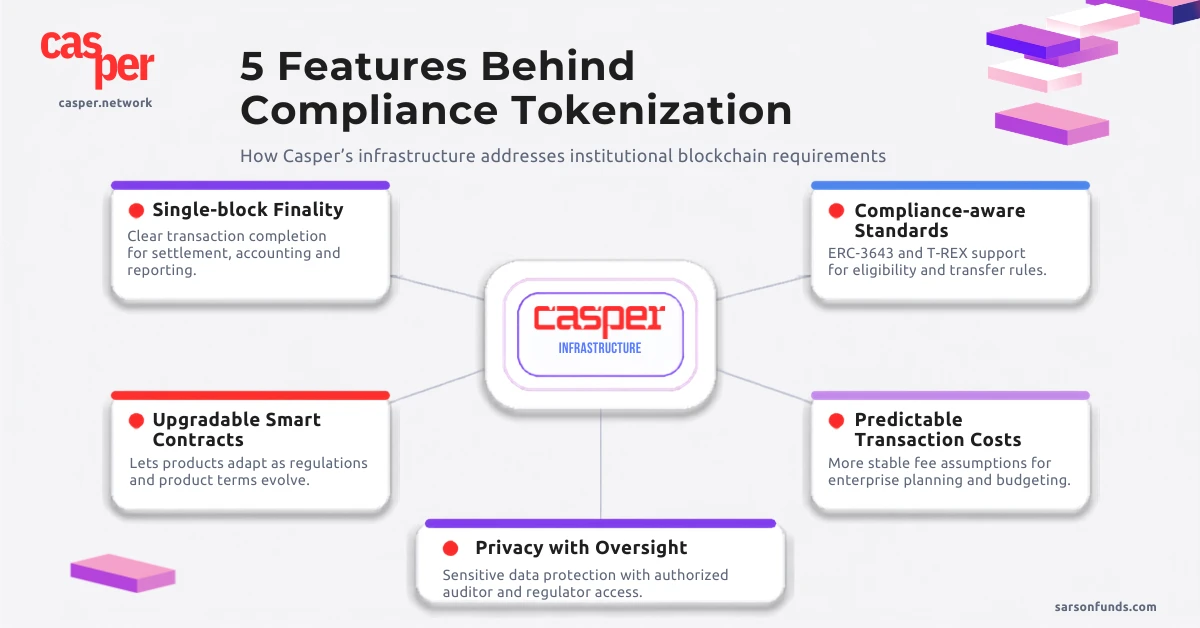
One of the most important features Casper highlights is single-block finality. In simple terms, once a transaction is finalized on Casper, participants have a clearer answer on when that transaction is complete. There is no extended period in which the transaction could still be reversed or reordered.
For everyday crypto users, that may sound like a technical detail. For a bank, fund administrator or compliance team, it can be central to operations. Institutions need to know when a trade is settled because accounting, reporting and regulatory processes depend on reliable transaction status. A blockchain that provides a clear settlement outcome may be easier for regulated firms to evaluate than one that leaves finality less certain.
Tokens That Follow the Rules
Casper also points to its support for compliance-aware tokenization frameworks, including ERC-3643 and T-REX.
ERC-3643 is a token standard designed for regulated assets. Unlike basic token standards built mainly for open, permissionless trading, ERC-3643 is intended to support identity checks, investor eligibility rules, transfer restrictions and jurisdictional controls. That matters because a tokenized bond, fund interest, private credit product or other regulated asset cannot simply move to anyone, anywhere, at any time. The asset must follow the rules attached to it.
T-REX, short for Token for Regulated Exchanges, is an implementation framework associated with ERC-3643. In plain language, it gives issuers a way to build tokens that can check whether a holder is eligible, whether a transfer is allowed and whether compliance conditions are being met before the asset moves.
For institutions, this is often not a minor feature. It can be the difference between a tokenization project that can survive legal review and one that cannot. This is why Casper’s infrastructure matters in the broader discussion around compliant tokenization: It helps connect blockchain functionality with the compliance workflows regulated financial products require.
Products That Can Change Over Time
Casper also emphasizes that its smart contracts, the software that runs on the network, can be updated. This sounds simple until considering that many blockchains treat contracts as permanent once deployed.
That design can work for simple use cases, but real-world financial products change over time. Regulations are updated. Reporting requirements evolve. A tokenized fund may need to adjust distribution logic. An issuer may need to correct an error. If the underlying contract cannot be updated, each change can require a difficult migration.
Casper’s approach is designed to allow products to evolve more like traditional financial instruments. For tokenized assets with long life cycles, that flexibility may become increasingly important.
Costs That Do Not Surprise You
Another feature Casper highlights is predictable transaction costs. On many blockchains, transaction fees can fluctuate based on network demand. That may be inconvenient for retail users, but it can be a significant obstacle for businesses.
Companies need cost visibility before they commit budgets, operations and client-facing products to a network. Casper sets transaction costs at the protocol level, giving institutions a clearer view of what activity on the network may cost over time. For regulated financial products, that predictability can support planning, pricing and operational controls.
Privacy and Transparency Working Together
Casper’s update also addresses privacy, one of the more complex issues in regulated finance. Public blockchains are transparent by default, which is valuable for open networks but can create challenges for institutions. Client identities, position sizes and trading strategies often must remain confidential.
At the same time, regulators, auditors and other authorized parties may need appropriate visibility. Casper is designed to support both needs by protecting sensitive information while allowing access for qualified oversight. Finding that balance is one of the central challenges in institutional blockchain adoption.
The Machine Economy Angle
Casper also connects these capabilities to the machine economy, where AI agents and automated systems may eventually need to make payments and settle transactions on their own.
The concept may still feel early, but the infrastructure requirements overlap with those of regulated assets. If an AI agent is making thousands of small payments, unpredictable fees could weaken the model. If automated systems trigger follow-on actions based on a transaction, they need to know the transaction is final. If regulators ask who authorized an action, the network needs to support accountability.
In that sense, the features Casper is highlighting for institutions today may also be relevant for automated systems in the future.
Why This Update Matters
Casper has said this update is part of a broader sequence covering ecosystem access, validators, staking, institutions and real-world asset initiatives. This particular announcement helps explain the foundation beneath that broader strategy.
From an institutional perspective, the key features are clear: transactions that finalize cleanly, tokens that can follow compliance rules, smart contracts that can evolve, transaction costs that are predictable and privacy controls that can coexist with transparency. That combination is important for firms evaluating where to bring financial products on-chain.
For those reasons, Casper’s infrastructure deserves attention from market participants watching the next phase of compliant tokenization and regulated real-world asset development.
Disclosures: This article is for informational purposes only and should not be considered financial, legal, tax, or investment advice. It provides general information on cryptocurrency without accounting for individual circumstances. Sarson Funds, Inc. does not offer legal, tax, or accounting advice. Readers should consult qualified professionals before making any financial decisions. Cryptocurrency investments are volatile and carry significant risk, including potential loss of principal. Past performance is not indicative of future results. The views expressed are those of the author and do not necessarily reflect those of Sarson Funds, Inc. By using this information, you agree that Sarson Funds, Inc. is not liable for any losses or damages resulting from its use.