Blockchain governance can be easier to understand when viewed through a familiar lens: how investors, companies and markets coordinate around important decisions. Blockchain networks do not have CEOs or boards that can unilaterally rewrite the rules. Instead, changes move through proposals, technical review, public discussion and adoption by the people and institutions that operate and use the network.
That process becomes especially important when a protocol faces a significant technical challenge. For example, American Fortress has proposed a quantum-resistance approach that, according to CoinDesk, would use a backward-compatible Bitcoin soft fork to help protect certain dormant legacy wallets from future quantum-related risks. The details of any such proposal would still need to move through Bitcoin’s broader improvement and consensus process before becoming part of the network.
What Is a Blockchain Protocol?
A blockchain protocol is the shared rulebook that defines how a network works. It determines how transactions are validated, how blocks are produced, how participants agree on the state of the ledger and what counts as valid activity.
Bitcoin, Ethereum and Solana each have their own protocol rules. Those rules are enforced by software run across distributed networks of participants. Because there is no central authority that can simply impose changes, protocol updates require coordination across the ecosystem.
That may sound unusual, but protocols are not unique to blockchains. The internet also runs on shared technical standards, including HTTP and TCP/IP. Most people use these protocols every day without asking who owns them or who votes on changes. In practice, these standards evolve through technical proposals, working groups, implementation, testing and broad adoption.
Blockchain networks follow a similar logic. Protocols can change, but durable changes require both technical merit and ecosystem support.
Key Participants: Nodes, Miners and Validators
To understand blockchain governance, it helps to define a few core participants.
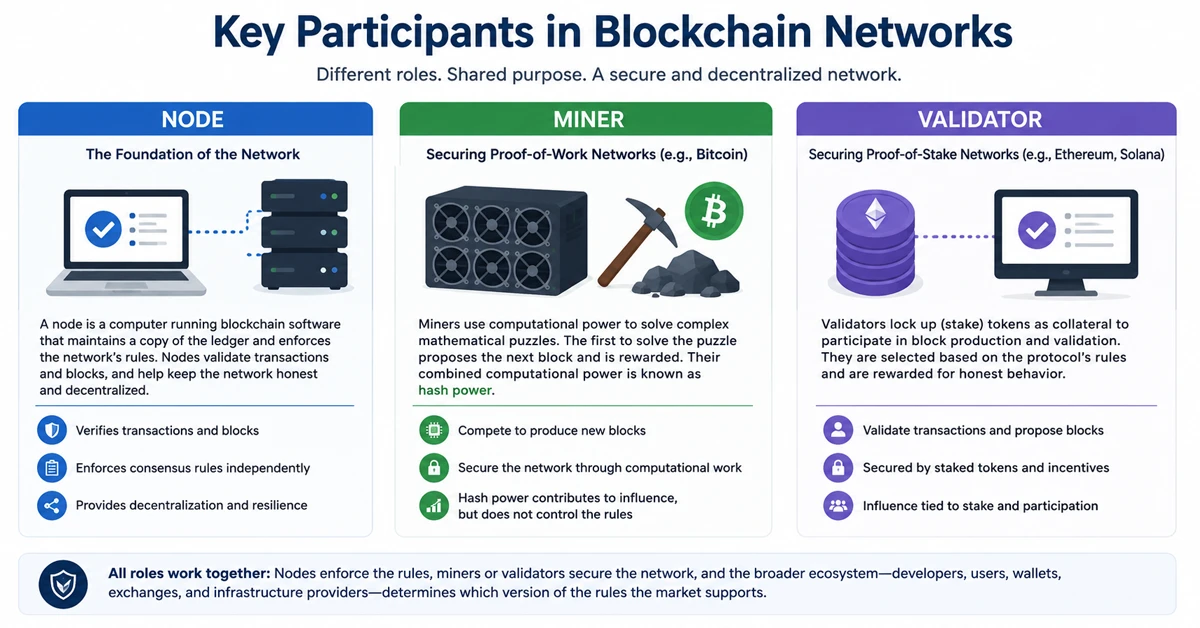
These distinctions matter because governance is not controlled by a single group. Developers may write code. Miners or validators may help secure the chain. Nodes enforce rules. Exchanges, wallets, custodians, applications and users determine whether a version of the network has real economic support.
Every Network Change Starts With a Proposal
Every meaningful blockchain change begins as a proposal. On Bitcoin, these are often formalized as Bitcoin Improvement Proposals, or BIPs. On Ethereum, they are known as Ethereum Improvement Proposals, or EIPs. On Solana, changes are typically discussed through public forums, developer channels and ecosystem coordination.
At this stage, a proposal is not a decision. It is an idea introduced to a market of participants.
Developers evaluate whether the change is technically sound. Miners or validators assess operational impacts. Businesses, wallets, custodians, exchanges and users consider whether the change supports the network’s long-term utility, security and economic credibility.
This resembles the way investors evaluate a corporate action. A merger, spinout, capital raise or governance amendment does not become meaningful simply because someone proposes it. Stakeholders assess the tradeoffs, form views and decide whether to support the path forward.
How a Soft Fork Works
A soft fork is a type of blockchain upgrade that tightens or adds rules while preserving backward compatibility for non-upgraded nodes. In plain language, upgraded participants begin enforcing a new standard, while non-upgraded participants can still remain compatible with the chain as long as the new activity also fits within the old rules.
This is why soft forks are often discussed for changes that aim to improve Bitcoin without forcing all participants onto a completely incompatible version of the network.
Still, a soft fork is not automatic. A proposal must be reviewed, debated, implemented, tested and activated. Miners may signal readiness. Node operators decide whether to run updated software. Wallets, exchanges and custodians assess whether they will support the change. Users and capital markets ultimately help determine whether the upgraded network has economic legitimacy.
In the American Fortress example, the proposed quantum-resistance solution would reportedly involve a soft fork to help protect vulnerable dormant wallets. That makes it a useful case study in how a technical proposal could enter the BIP process and, only if sufficiently supported, move toward activation.
The Shareholder Analogy Helps, With Limits
The shareholder comparison is useful because it makes blockchain governance more familiar. In public companies, shareholders can influence major decisions through ownership, voting rights and market behavior. Larger shareholders often carry more influence because they have more capital at stake.
Blockchain networks also rely on economic alignment, but the process is different from a formal shareholder vote.
In Bitcoin, miners can signal support through hash power, but miners do not have the final word by themselves. Full nodes, users, developers, exchanges, wallets, custodians and markets all contribute to whether a proposed change becomes meaningful.
In Proof-of-Stake networks, validators have influence because they help operate the network and stake capital. Token holders, application developers, infrastructure providers and ecosystem participants also shape the outcome through adoption and economic activity.
The common thread is that influence is connected to participation. The difference is that blockchain systems coordinate through software, open discussion and market adoption rather than corporate bylaws and legal voting procedures.
Voting Often Happens Through Adoption
Unlike traditional shareholder voting, blockchain governance is often not conducted through explicit ballots. Participants frequently “vote” by choosing which software to run, which chain to support, which assets to hold and which infrastructure to integrate.
If enough economically relevant participants align behind a proposal, the new rules can become the standard. If support is weak, the proposal may be delayed, revised or abandoned. In more contentious situations, a network can split into separate versions, known as a fork.
A fork is not necessarily a failure. It is one possible outcome when participants disagree about the future rule set. Each resulting network then has to earn support from users, developers, infrastructure providers and markets.
Internet Protocols Offer a Useful Comparison
The internet offers another helpful analogy. No single company dictates the basic standards that make the web work. HTTP, TCP/IP and other protocols have evolved through technical coordination, implementation and broad adoption.
Most users do not see this process. They simply experience the internet working. Behind the scenes, however, standards can change when technical communities identify better approaches and enough of the ecosystem adopts them.
Blockchain networks are similar in that they depend on shared rules. Those rules are not static forever, but they also cannot be changed casually. Protocol upgrades require a combination of technical credibility, testing, coordination and market acceptance.
A Market-Driven Governance Model
For investors, the most important takeaway is that blockchain governance is not the absence of governance. It is a different governance model.
Traditional finance relies on boards, management teams, regulators, shareholder votes and legal contracts. Blockchain networks rely on open-source software, distributed infrastructure, economic incentives and participant adoption.
That model can be slower than corporate decision-making. It can also be more transparent. Proposals are often public. Technical debates are visible. Adoption can be observed through software upgrades, validator or miner signaling, node behavior and market support.
The process is not perfectly comparable to shareholder governance, and it is not perfectly comparable to internet standards. It has elements of both. Ownership and economic participation matter, but so do technical implementation and broad network coordination.
Why This Matters
As blockchain networks mature, questions about upgrades, security and long-term resilience will become increasingly important. Quantum resistance is one example. Scalability, privacy, fees, decentralization and interoperability are others.
Understanding blockchain governance helps investors see these changes in context. A proposal is not the same as an upgrade. Signaling is not the same as activation. Miner or validator support is important, but so is broader economic adoption.
The result is a governance process that may look unfamiliar at first, but follows a recognizable pattern: propose, debate, test, coordinate and adopt. In that sense, blockchain protocols are not outside the world of governance. They are a new expression of it.
Disclosures: This article is for informational purposes only and should not be considered financial, legal, tax, or investment advice. It provides general information on cryptocurrency without accounting for individual circumstances. Sarson Funds, Inc. does not offer legal, tax, or accounting advice. Readers should consult qualified professionals before making any financial decisions. Cryptocurrency investments are volatile and carry significant risk, including potential loss of principal. Past performance is not indicative of future results. The views expressed are those of the author and do not necessarily reflect those of Sarson Funds, Inc. By using this information, you agree that Sarson Funds, Inc. is not liable for any losses or damages resulting from its use.