The reported shutdown of Anthropic’s advanced AI models is not just a story about one company or one government order. It is a warning about the risk of centralized AI.
When the most powerful AI tools are controlled by a small number of centralized companies, access can change quickly. A model can be restricted, gated, repriced, redirected, or taken offline. The reason may be national security, regulation, corporate policy, payment controls, licensing terms, or political pressure.
For users, builders, and enterprises, the result is the same: critical AI access depends on infrastructure they do not control.
That is the case for decentralized AI.
The Problem Is Centralized Control
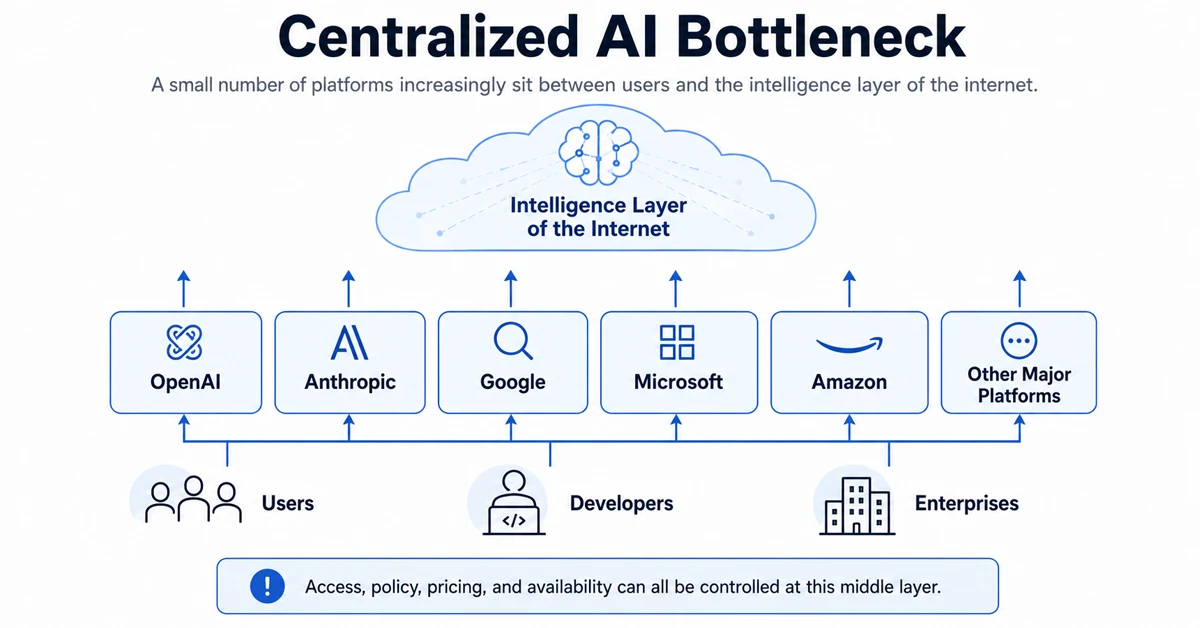
Anthropic may be the latest example, but it is not the only company at the center of this issue. OpenAI, Anthropic, Google, Microsoft, Amazon, and a small number of other major platforms increasingly sit between users and the intelligence layer of the internet.
That concentration creates convenience. Centralized platforms are easy to use, well funded, and capable of scaling quickly. But it also creates dependency.
If one company controls the model, API, account access, data policy, pricing, and infrastructure stack beneath the product, then users are not operating on neutral rails. They are operating inside someone else’s permissioned environment.
For developers, that can mean an application breaks because an API policy changes. For enterprises, it can mean sensitive workflows depend on infrastructure that can be constrained by another company or government. For global markets, it raises a larger question: who decides who gets access to advanced AI?
That question is no longer theoretical.
AI Is Becoming Infrastructure
The AI conversation is still dominated by model performance. Which system writes better code? Which model reasons better? Which chatbot is faster, cheaper, or more capable?
Those questions matter. But they are not the whole story.
As AI becomes embedded in software, finance, cybersecurity, research, operations, and personal productivity, access itself becomes an infrastructure question. Compute, inference, storage, data access, identity, payments, and agent deployment are all part of the emerging AI stack.
If those layers remain controlled by a handful of corporate platforms, AI inherits the same fragility that already exists across much of the web.
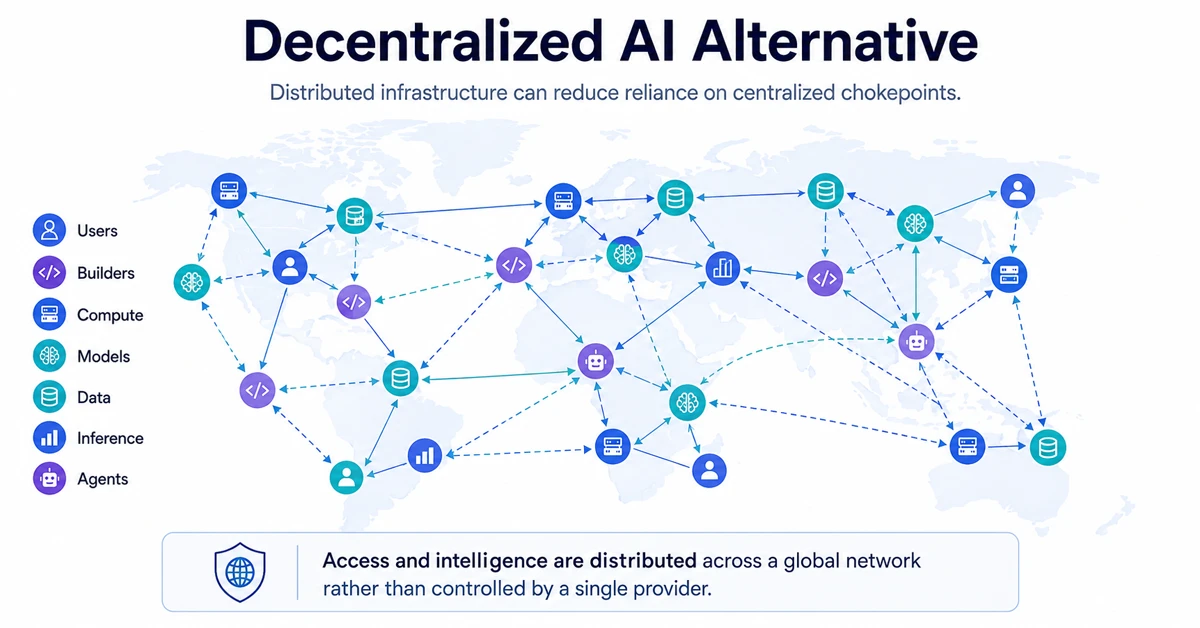
Decentralized AI offers a different path. It does not eliminate the need for safety, governance, or quality control. But it reduces reliance on single points of failure. It gives users and builders alternatives when centralized platforms become unavailable, restrictive, or politically constrained.
Where Decentralized AI Fits
Decentralized AI is not one product or one protocol. It is a category of networks and platforms attacking different parts of the same problem.
Morpheus focuses on open-source, peer-to-peer personal AI. In a future where agents manage workflows, wallets, research, automation, and digital identity, personal AI should not depend entirely on a platform that can change the rules without user consent.
Manifest Network is building decentralized infrastructure for AI and cloud services. This is the layer beneath the user-facing application: compute, deployment, data ownership, and network resilience. Manifest’s thesis is that builders need sovereign infrastructure, not just another centralized cloud option.
Bittensor, powered by TAO, addresses the machine-intelligence market itself. Rather than concentrating AI development inside closed corporate labs, Bittensor creates an incentive network where participants can contribute intelligence, compete, and be rewarded.
Venice addresses the user-facing side of the equation: private AI access without the same data surrender common across mainstream platforms. As prompts increasingly include business strategy, code, financial questions, legal drafts, and confidential work product, privacy becomes part of the infrastructure layer.
These projects are not interchangeable. But they point in the same direction: away from closed AI dependence and toward networks designed for resilience, privacy, and user control.
The Real Question Is Control
The AI race is often framed as a competition over model performance. The deeper race is about control.
Who controls the compute?
Who controls the data?
Who controls access?
Who controls the models?
Who controls the economic value created by AI?
Centralized AI answers those questions in favor of large technology companies and the governments that can influence them. Decentralized AI offers a different answer: access and ownership can be distributed across users, builders, infrastructure providers, and open networks.
That does not mean decentralized AI wins overnight. The category still has work to do on usability, performance, liquidity, developer tooling, and trust. But the market signal is becoming clearer. Every time a centralized platform restricts access, changes terms, or becomes subject to geopolitical pressure, the case for decentralized alternatives gets stronger.
The Anthropic shutdown is not an isolated headline. It is a preview of the AI infrastructure debate ahead.
As artificial intelligence becomes more powerful, the question will not simply be whether people use AI. They will. The question is whether they access it through closed systems controlled by a few companies, or through open networks designed for resilience, privacy, and user ownership.
That is why decentralized AI matters now.
Disclosures: This article is for informational purposes only and should not be considered financial, legal, tax, or investment advice. It provides general information on cryptocurrency without accounting for individual circumstances. Sarson Funds, Inc. does not offer legal, tax, or accounting advice. Readers should consult qualified professionals before making any financial decisions. Cryptocurrency investments are volatile and carry significant risk, including potential loss of principal. Past performance is not indicative of future results. The views expressed are those of the author and do not necessarily reflect those of Sarson Funds, Inc. By using this information, you agree that Sarson Funds, Inc. is not liable for any losses or damages resulting from its use.