What Tempo Is and Why It Exists
Tempo Blockchain is a payments-first Layer-1 blockchain co-built by Stripe and Paradigm. In plain terms, a Layer-1 blockchain is the base network where transactions are processed and finalized. Tempo was built to address what its backers describe as a persistent gap between stablecoins and commercial-scale global payments.
Stripe, which processed $1.9 trillion in payment volume in 2025 alone, found that existing blockchains were largely architected for trading and speculation rather than the high-throughput, low-cost settlement that real commerce requires. Tempo is designed to address that gap. The chain targets more than 100,000 transactions per second, 600-millisecond finality, and fees of less than one-tenth of a cent per transaction. Gas fees can be paid in major stablecoins, removing the need for a volatile native token. Mainnet went live in March 2026.
Tempo is not operating in a vacuum. Circle’s Arc, Tether’s Plasma, Solana, Ethereum and Base all have active stablecoin payment strategies. Even so, several of the world’s largest payment and financial institutions are building around Tempo Blockchain, suggesting that the network’s institutional positioning may be emerging as a defining advantage.
The Card Network Endorsement
One of the clearest signals of Tempo’s institutional credibility came on April 14, 2026, when Visa launched a dedicated validator node on the Tempo blockchain, joining Stripe and Standard Chartered’s Zodia Custody as one of three anchor validators on the network.
This was more than a marketing announcement. Visa reportedly spent six months building the internal infrastructure required to run a node that verifies and finalizes transactions on-chain. For a company operating across more than 200 countries and handling trillions of dollars in annual payment volume, that level of engineering investment suggests a strategic commitment.
Mastercard also joined Tempo’s Crypto Partner Program in March 2026. Together, those moves place both global card networks inside the Tempo Blockchain ecosystem, a distinction no competing stablecoin-focused chain currently matches based on the comparison set below.
The Partner Ecosystem
Tempo’s partner roster is what most clearly separates it from earlier institutional blockchain efforts. Its ecosystem spans consumer platforms, fintech leaders, global banks and AI companies, pointing to a broader payments strategy rather than a single niche use case. Instead of relying on pilot programs alone, Tempo is building around partners tied to payroll, merchant settlement, cross-border transfers, institutional banking infrastructure and machine payments.
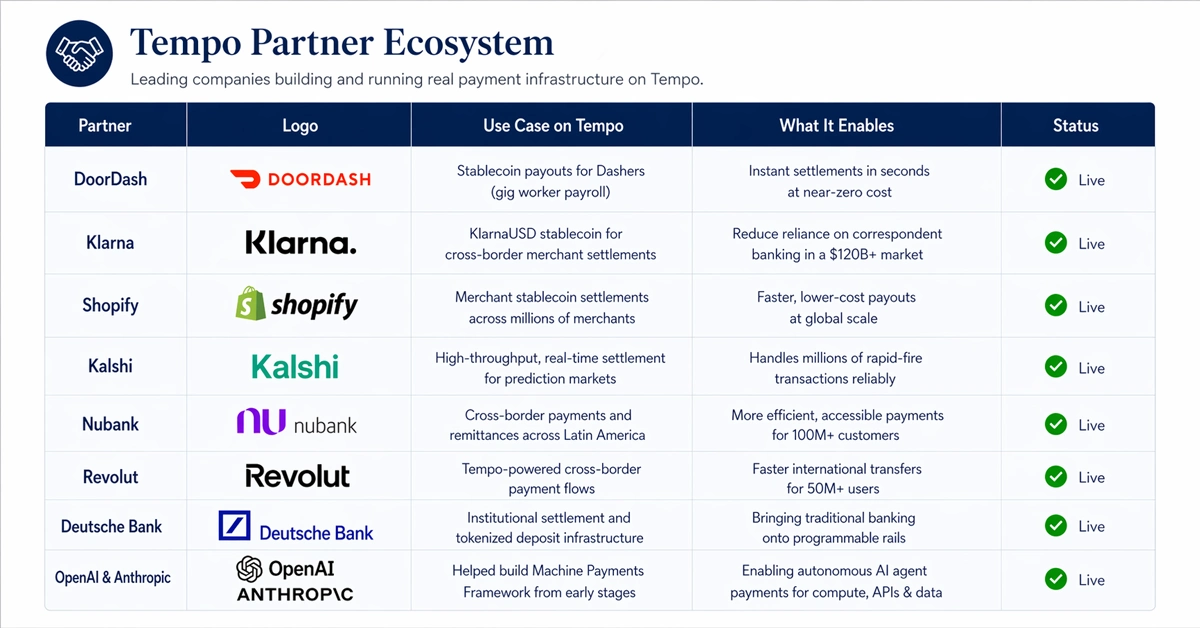
This breadth matters because it shows Tempo is being positioned as shared payment infrastructure across multiple industries. Consumer platforms such as DoorDash, Klarna and Shopify bring transaction volume, while firms including Deutsche Bank, Nubank and Revolut extend the network into regulated financial use cases. OpenAI and Anthropic add a separate machine-payments dimension that few competing chains can yet match.
Enterprise Privacy: Tempo Zones
One of the most significant product launches alongside Tempo’s expansion is Tempo Zones, a private stablecoin execution environment for enterprise payroll and treasury operations.
The problem it addresses is straightforward. Running payroll on a public blockchain can expose salary information on-chain by default. Tempo Zones allows a company to fund a payroll account inside a private environment, execute payments without publishing transaction details publicly, and let recipients withdraw to Tempo Mainnet for off-ramps. In effect, the payroll ledger does not appear on a public blockchain.
That approach materially expands the addressable market for Tempo Blockchain by making the network more practical for enterprises managing compensation and treasury functions at scale.
The AI Payments Angle
Tempo is also building infrastructure for machine-to-machine commerce. The Machine Payments Protocol, co-launched with Stripe in March 2026, allows AI agents to pay autonomously for compute, APIs and datasets without case-by-case human approval, operating natively on Tempo.
Anthropic and OpenAI helped shape the protocol early on. As agentic AI systems begin to consume cloud infrastructure and digital services more independently, the payment rails behind those micropayments could become increasingly important. Tempo is positioning itself as early infrastructure for that use case.
Stripe also added Tempo as a native network option on its developer platform in March 2026, making Tempo Blockchain available across a large existing payment stack in a single integration step.
Competitive Landscape
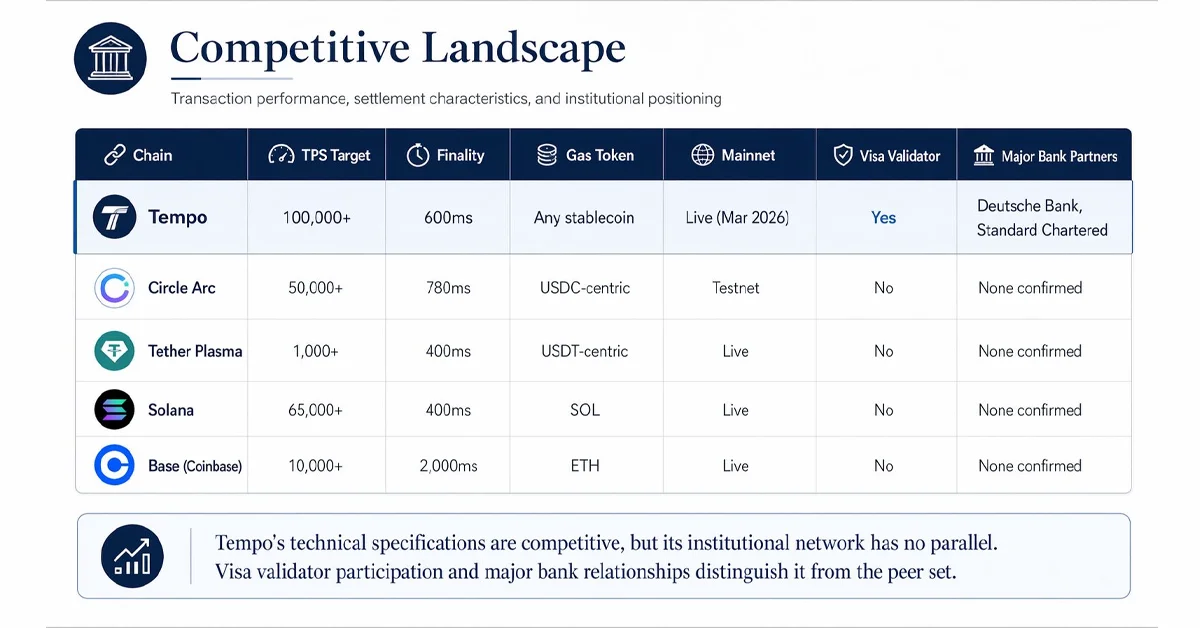
Tempo’s technical specifications are competitive, but its more notable differentiator may be the concentration of institutional participants around the network. Visa is an active validator. Mastercard is a program partner. Global banks are building tokenized settlement infrastructure. Consumer platforms including DoorDash, Klarna, Shopify and Kalshi are tied to live or active implementations. On this view, technical performance is necessary, but institutional network density may be the more durable strategic advantage.
What It All Means
The broader backdrop is the rapid growth of stablecoin-based payments. With $400 billion in stablecoin transaction volume recorded in 2025, up 100% year over year, and 60% of that activity coming from B2B transactions, the market opportunity is expanding quickly. Stablecoins are increasingly moving from crypto-native experimentation into operational payment infrastructure.
That matters in a global cross-border payments market estimated at $190 trillion annually. Traditional correspondent banking networks often take one to three days to settle and can involve opaque intermediary fees. Tempo’s proposition is a much faster and lower-cost alternative, with settlement measured in milliseconds rather than days.
What Tempo has built, however, is not just a performance case. It is a network effect. When companies such as DoorDash, Klarna, Shopify, Kalshi, Nubank, Revolut and Deutsche Bank are building on the same chain, each new participant potentially increases the network’s usefulness for the next. That is the core argument behind Tempo Blockchain’s momentum: not simply that it is fast, but that it is attracting the institutions most likely to drive stablecoin payments into mainstream commercial use.
Disclosures: This article is for informational purposes only and should not be considered financial, legal, tax, or investment advice. It provides general information on cryptocurrency without accounting for individual circumstances. Sarson Funds, Inc. does not offer legal, tax, or accounting advice. Readers should consult qualified professionals before making any financial decisions. Cryptocurrency investments are volatile and carry significant risk, including potential loss of principal. Past performance is not indicative of future results. The views expressed are those of the author and do not necessarily reflect those of Sarson Funds, Inc. By using this information, you agree that Sarson Funds, Inc. is not liable for any losses or damages resulting from its use.